Weiterbewilligungsantrag (WBA): what belongs in every item
The Weiterbewilligungsantrag (WBA) extends a running Bürgergeld: 6 pages, 27 numbered items. At its core it is the Hauptantrag, cut down to what may have changed: your current address, the costs of accommodation and heating, the income of the Bedarfsgemeinschaft and anything new. Place of birth, residence permit and the five-year history are gone, the Jobcenter already knows those. It has to arrive before the approval period ends, otherwise a gap in payments opens up. This guide walks through the form page by page: above you see the original page, below it what belongs in each item. The fields on the images are interactive: hover over them or tap them. You see the same explanations while filling it in the PDeF editor, in German, Russian and Ukrainian.
1. Page 1: period, your details and the housing situation (items 1-9)
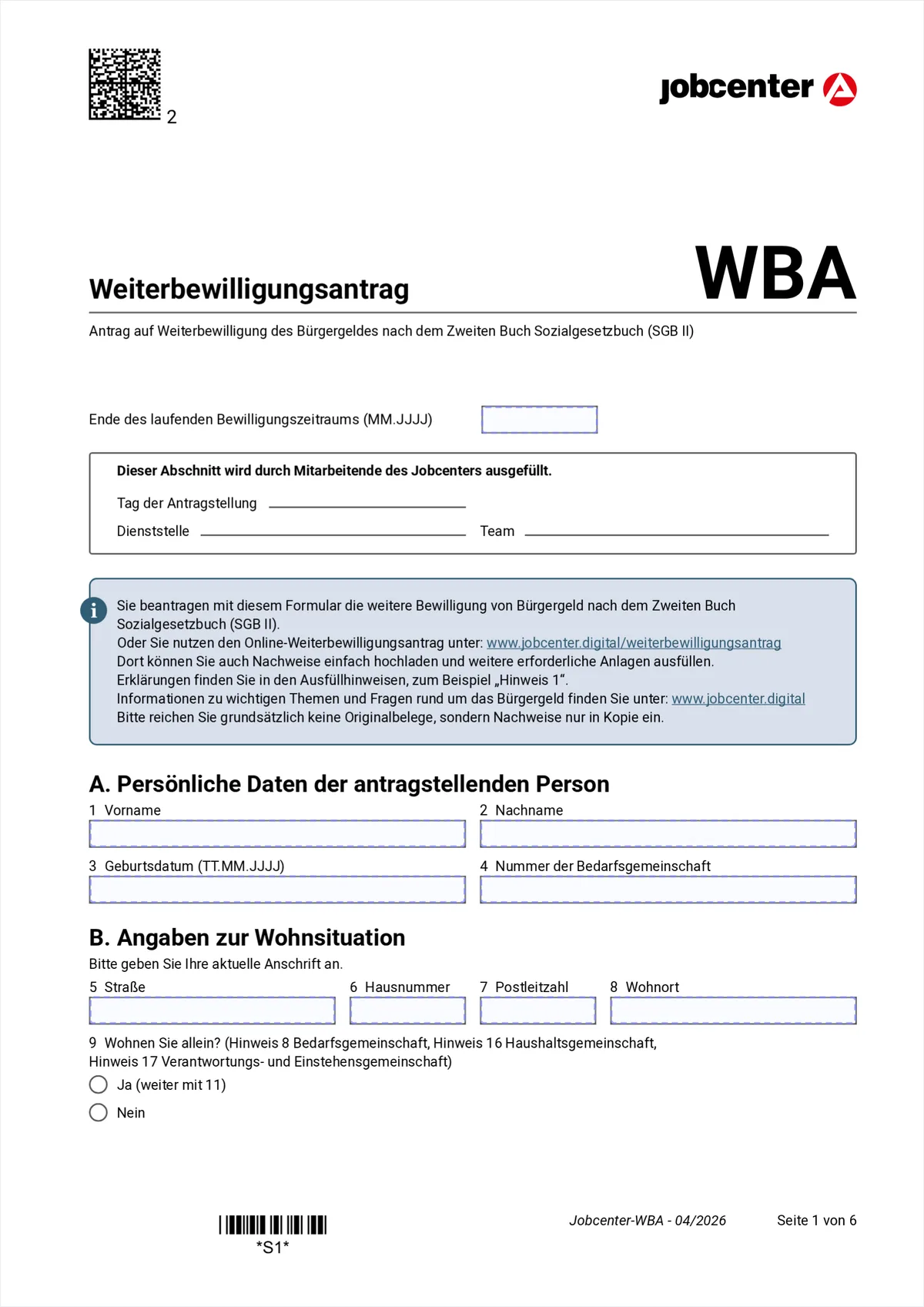
Hover or tap a marked field to see the explanation. Right at the top sits the field that is filled in wrongly most often: what is asked for is the END of the CURRENT period, not the start of the new one. The date is in your current approval decision.
- Head
- End of the current approval period in the format MM.YYYY. The grey box below it is filled in by the Jobcenter.
- 1-3
- First name, surname and date of birth.
- 4
- Bedarfsgemeinschaft number. Unlike in the first application it is not optional here: it is printed at the top of every letter from your Jobcenter.
- 5-8
- Your CURRENT address. If you have moved, enter the new one here; the move itself additionally belongs in item 23 or 26.
- 9
- Do you live alone. If yes, jump straight to item 11 and leave the table of people empty.
Section A: your details
Section B: housing situation
2. Page 2: the people you live with and the housing costs (items 10-15)
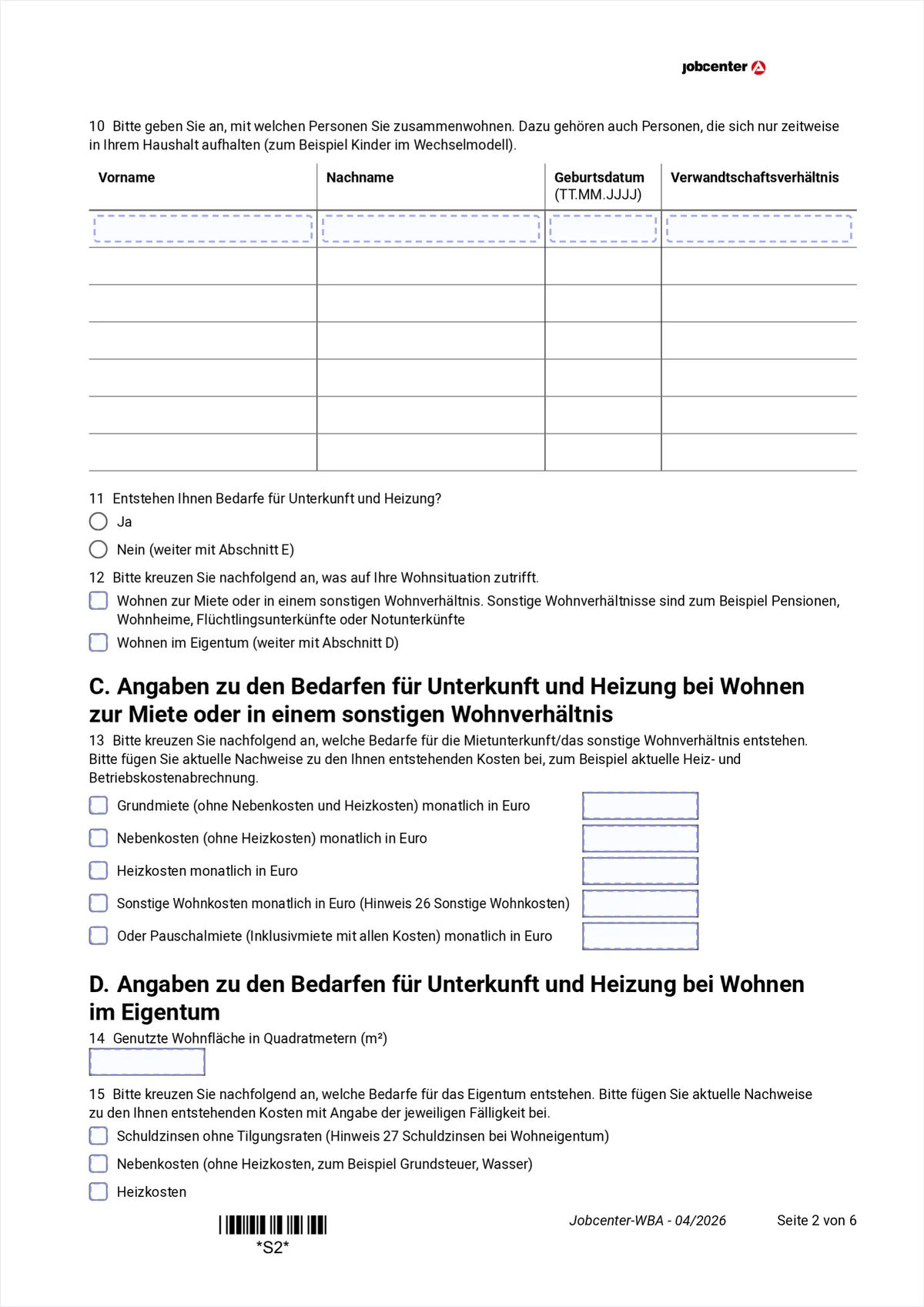
Hover or tap a marked field to see the explanation. Two switches on one page: item 11 can skip sections C and D completely, item 12 decides which of the two you fill in. The other one stays empty.
- 10
- Table of the people you live with: first name, surname, date of birth, relationship. This explicitly includes people who are only in the household PART of the time, such as children in a shared-custody arrangement.
- 11
- Do you have costs for accommodation and heating. If no, jump straight to section E.
- 12
- Renting or another housing arrangement such as a guesthouse, hostel or emergency shelter, OR owning. With ownership continue with section D.
- 13
- Every line has a box and a field for the monthly amount: basic rent without service charges and heating, cold service charges, heating costs, other housing costs. Only with an all-inclusive rent do you use the last line instead. Attach the current heating and service-charge statement.
- 14-15
- Living space used in square metres, then tick: debt interest without repayment instalments, service charges without heating such as property tax and water, and heating costs. Repaying the loan does not count, only the interest.
Section C: renting
Section D: owning
3. Page 3: income from work and what comes off it (items 16-19)
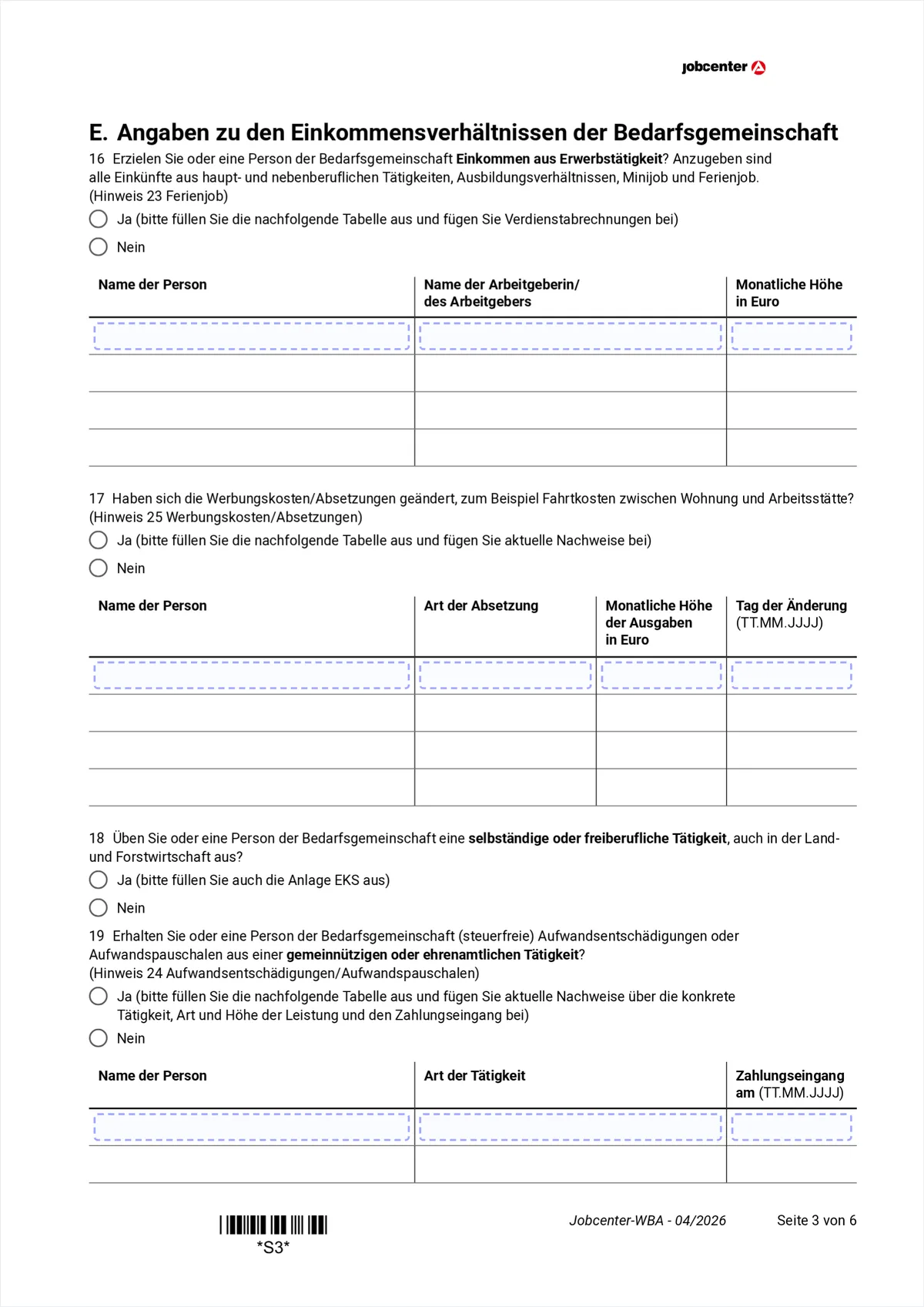
Hover or tap a marked field to see the explanation. Section E asks about the income of the WHOLE Bedarfsgemeinschaft, not only yours. Each of the four questions has its own small table below it when answered with yes.
- 16
- Income from work for you or a person in the Bedarfsgemeinschaft. That means any activity: a main job, a side job, an apprenticeship, a mini-job, a holiday job. The table below: name of the person, name of the employer, monthly amount. Attach payslips.
- 17
- Have the work-related expenses changed, for example the cost of travelling to work. These expenses REDUCE the countable income, so reporting them pays. Table: person, kind of deduction, monthly amount, day of the change.
- 18
- Self-employed or freelance work, including in agriculture and forestry. If yes, the Anlage EKS comes on top.
- 19
- A tax-free expense allowance from charitable or voluntary work. Table: person, kind of activity, day the payment arrived. Up to an allowance it is not counted.
4. Page 4: social benefits, other income and foreseeable changes (items 20-25)
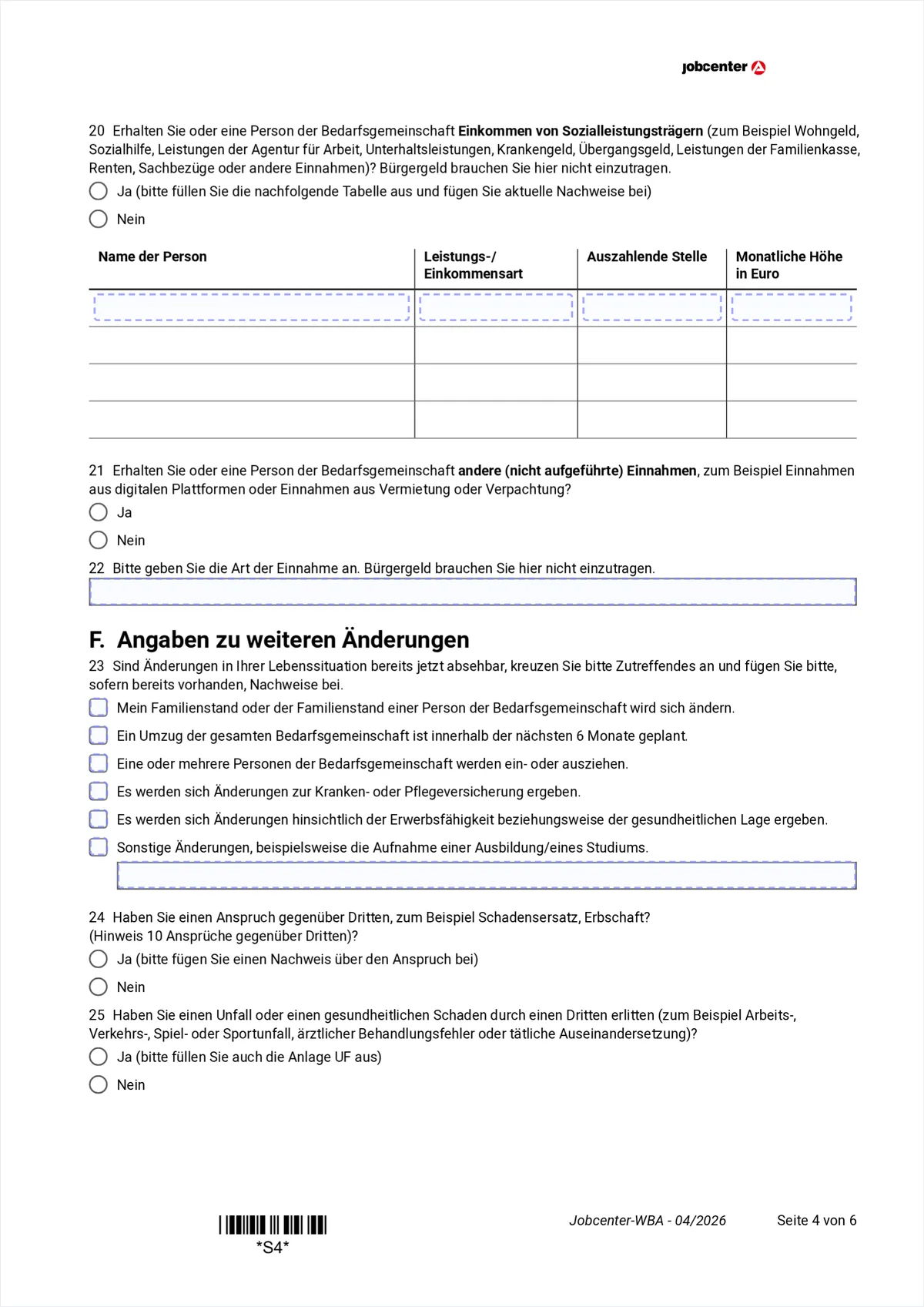
Hover or tap a marked field to see the explanation. Item 20 collects everything that comes from other bodies. One sentence in it is often missed: you do NOT enter the Bürgergeld itself here.
- 20
- Income from social agencies: Wohngeld, Sozialhilfe, benefits from the Agentur für Arbeit, maintenance, Krankengeld, Übergangsgeld, benefits from the Familienkasse such as Kindergeld, pensions and payments in kind. Table: person, kind, paying body, monthly amount. The Bürgergeld itself does NOT belong here.
- 21-22
- Other income not listed above and its kind, for example income from digital platforms or from letting and leasing.
- 23
- Six boxes for changes that are already foreseeable: marital status, a move of the whole Bedarfsgemeinschaft planned within 6 months, people moving in or out, changes to health or care insurance, changes to employability or health, other changes such as starting a course of training.
- 24
- Money claims against others, for example damages or an inheritance. If yes, attach evidence.
- 25
- An accident or health damage caused by another person. If yes, the Anlage UF comes on top.
Section F: what will change
5. Page 5: what you have not reported yet (item 26)
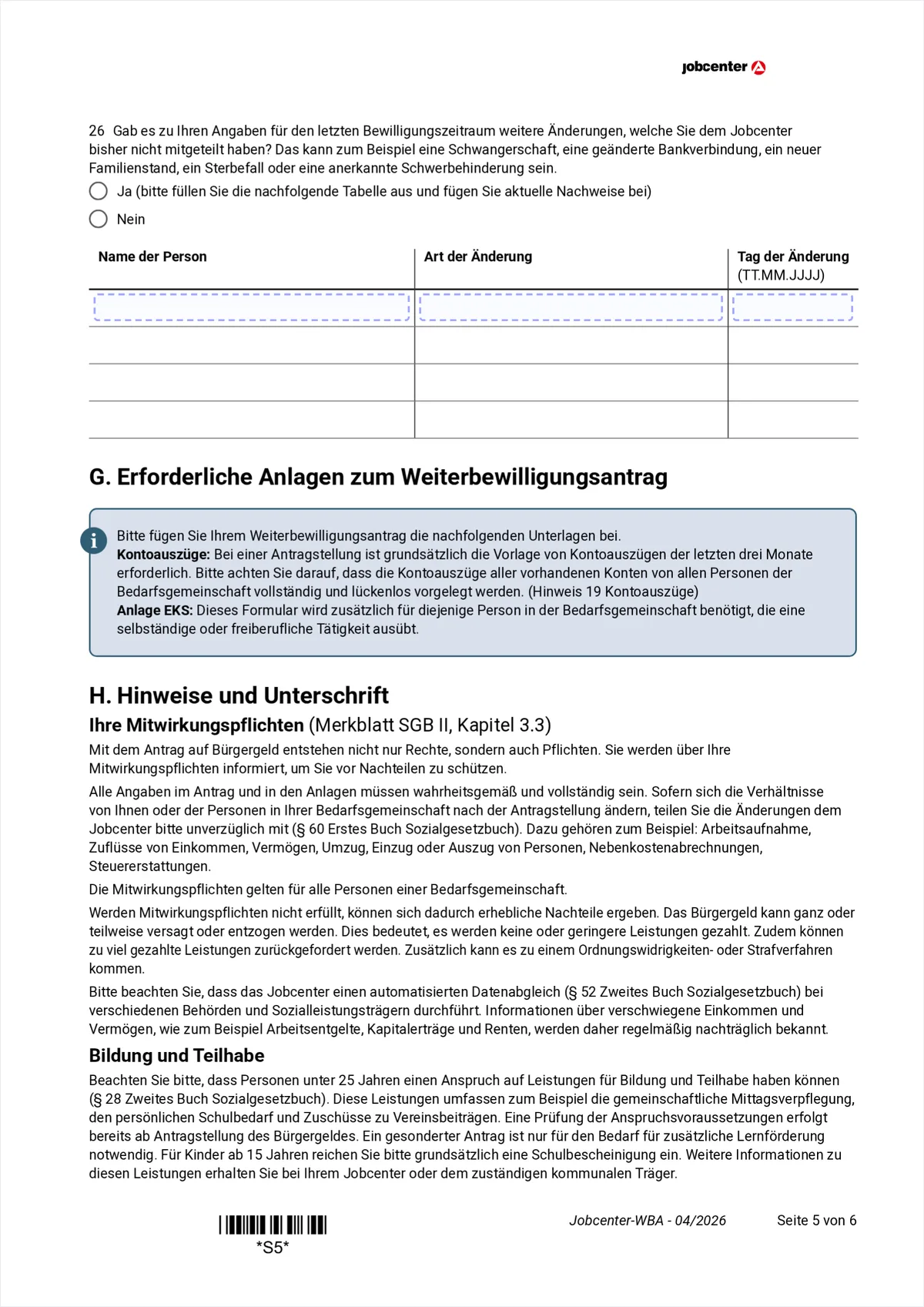
Hover or tap a marked field to see the explanation. This page is the form's second chance. Anyone who forgot to report a change in the last period enters it here. That is considerably better than the Jobcenter finding it later during a data comparison.
- 26
- Were there changes in the last approval period you have not reported yet. The form names for example a pregnancy, changed bank details, a new marital status, a death or a recognised severe disability. In the table below: person, kind of change, date. Attach current evidence.
6. Page 6: notes and signature (item 27)
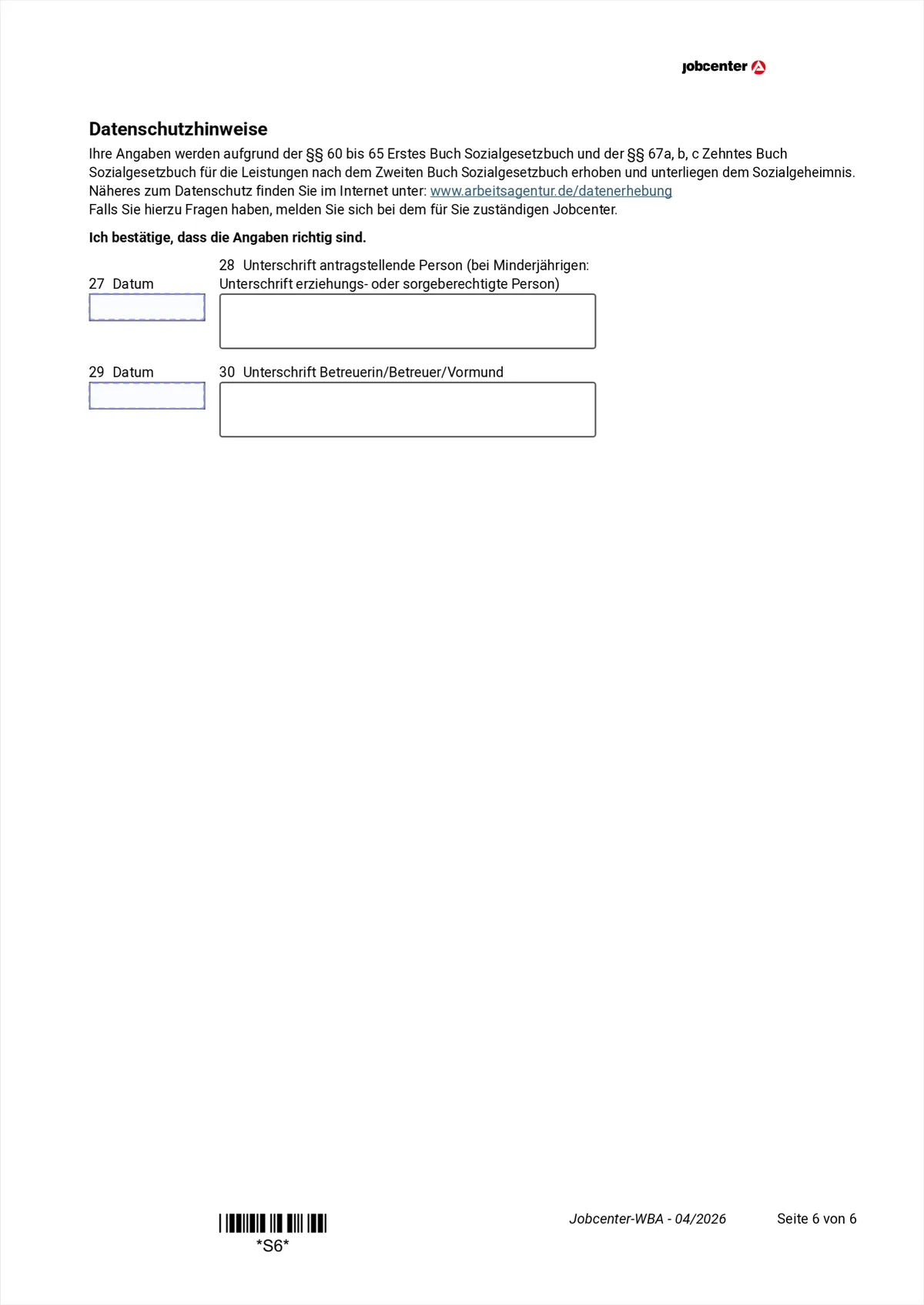
Hover or tap a marked field to see the explanation. Finally the duties and the signature. Without a signature the application counts as not filed, and that is exactly how the payment gap this application is meant to prevent comes about.
- 27
- Date and signature. For minors a parent or the legal guardian signs; with legal guardianship the guardian signs below.
7. How to fill in the WBA with explanations right on the form
Download the Weiterbewilligungsantrag from jobcenter.digital or arbeitsagentur.de and open it in the free PDeF editor in your browser. The editor recognises the form automatically and explains every field in plain language. What is especially handy with this application: it comes round every six months. Next time, open the same file again and the editor restores your entries so you only change what has changed. You can sign via QR code with your phone. The file is not uploaded to a server: everything happens in your browser.

Tips
- The field at the very top wants the END of the CURRENT approval period, not the start of the new one. It is the mistake made most often.
- Submit early: the application has to be with the Jobcenter before the current period ends, otherwise a gap in payments opens up.
- Item 20 explicitly excludes the Bürgergeld itself. Entering it there inflates your income on paper.
- Item 26 is the second chance: reporting a forgotten change here is far better than a repayment demand after the next data comparison.
Note, not legal advice: which evidence your Jobcenter requires in your case is stated in the covering letter and in the official filling instructions. When in doubt, ask your caseworker or a social advice centre.
Werbung
Frequently asked questions
When do I have to submit the Weiterbewilligungsantrag?
Before the current approval period ends. The date is in your current decision, and the form asks for exactly that month at the top. Submitted late, a gap in payments can open up.
Do I have to fill in everything again?
No. The WBA is the short form: it asks for the current address, the housing costs, the income and anything that has changed. Place of birth, residence permit and the five-year history are not asked again.
Do I enter the Bürgergeld in item 20?
No. Item 20 covers income from other bodies, for example Wohngeld, Kindergeld or a pension. The Bürgergeld itself is explicitly excluded.
What if I forgot to report something last period?
Enter it in item 26. That is what the item is there for, and reporting it now is much better than the Jobcenter discovering it later and reclaiming the money.
Do I have to list children who only live with me part of the time?
Yes. Item 10 explicitly includes people who are in the household only temporarily, such as children in a shared-custody arrangement.
Can I reuse last time's application?
Yes. Save the filled PDF; six months later you open it in the editor again, your entries are restored and you only change what has changed.
Free, no account, nothing uploaded to a server
Fill a PDF now