Anlage EK: what belongs in every item of the form
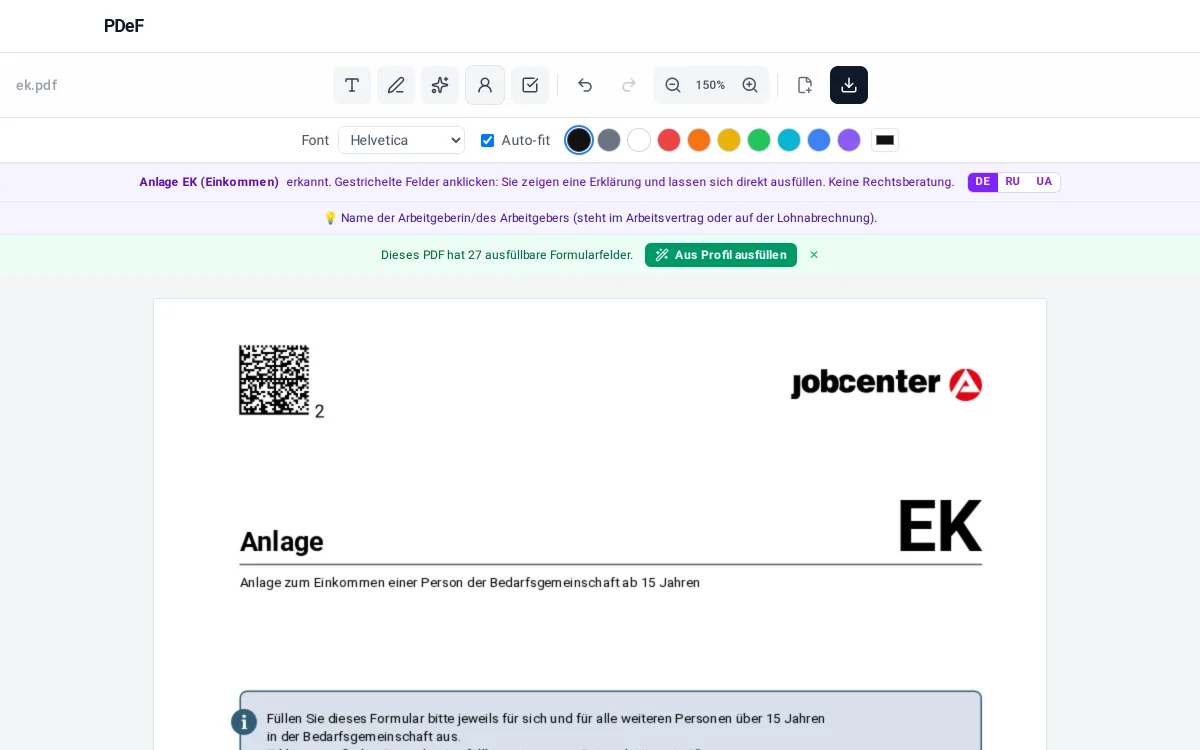
With the Anlage EK you declare income to the Jobcenter: 4 pages, 41 numbered items. It is filled in separately for EVERY person aged 15 and over in the Bedarfsgemeinschaft, so a couple with a 16-year-old fills it in three times. This guide walks through the form page by page: above you see the original page, below it what belongs in each item and where to find the figure. The fields on the images are interactive: hover over them or tap them and the explanation for that field appears. You see the same explanations while filling it in: the PDeF editor recognises the official EK and labels every field in plain language.
1. Page 1: two people, one question (items 1-8)
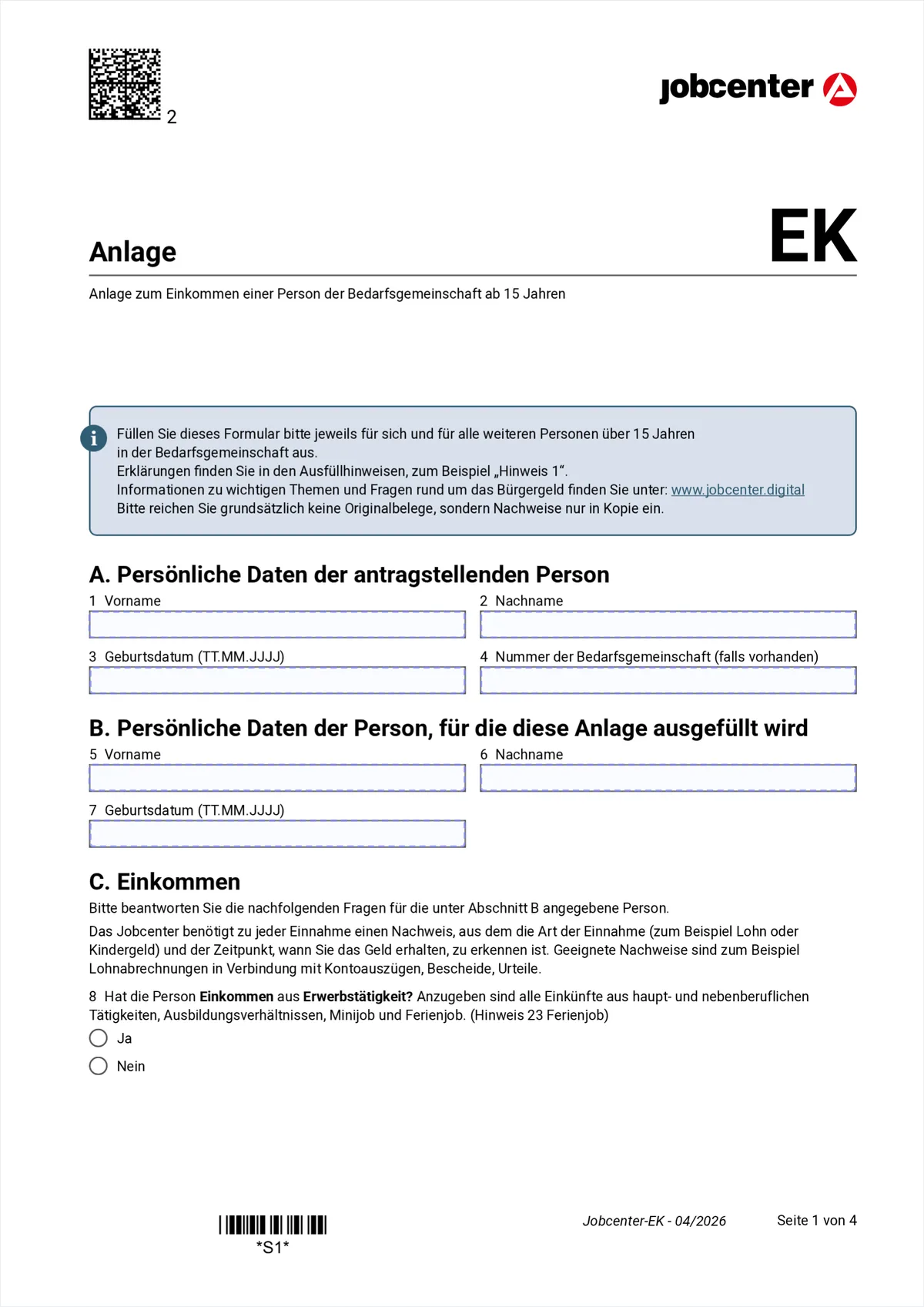
Hover or tap a marked field to see the explanation. The most common confusion sits right at the top: the form asks about TWO people. Section A is always the applicant, section B is the person whose income this particular copy is about. If you fill in your own EK, A and B hold the same details.
- 1-2
- First name and surname of the applicant, that is the person who signs the Hauptantrag.
- 3
- Their date of birth in the format DD.MM.YYYY.
- 4
- Bedarfsgemeinschaft number, if you already have one. It is printed at the top of every letter from the Jobcenter. Leave it empty on a first application.
- 5-7
- First name, surname and date of birth of the person whose income this Anlage describes. Every person aged 15 and over in the Bedarfsgemeinschaft gets their own EK.
- 8
- Does this person have income from work. That means any activity: a main job, a side job, an apprenticeship, a mini-job and a holiday job too. If no, items 9 to 20 stay empty. For every income the Jobcenter needs evidence showing both the kind AND the timing, that is a payslip together with the bank statement.
Section A: who is applying
Section B: who this is about
Section C: income
2. Page 2: employers and the list of all income (items 9-23)
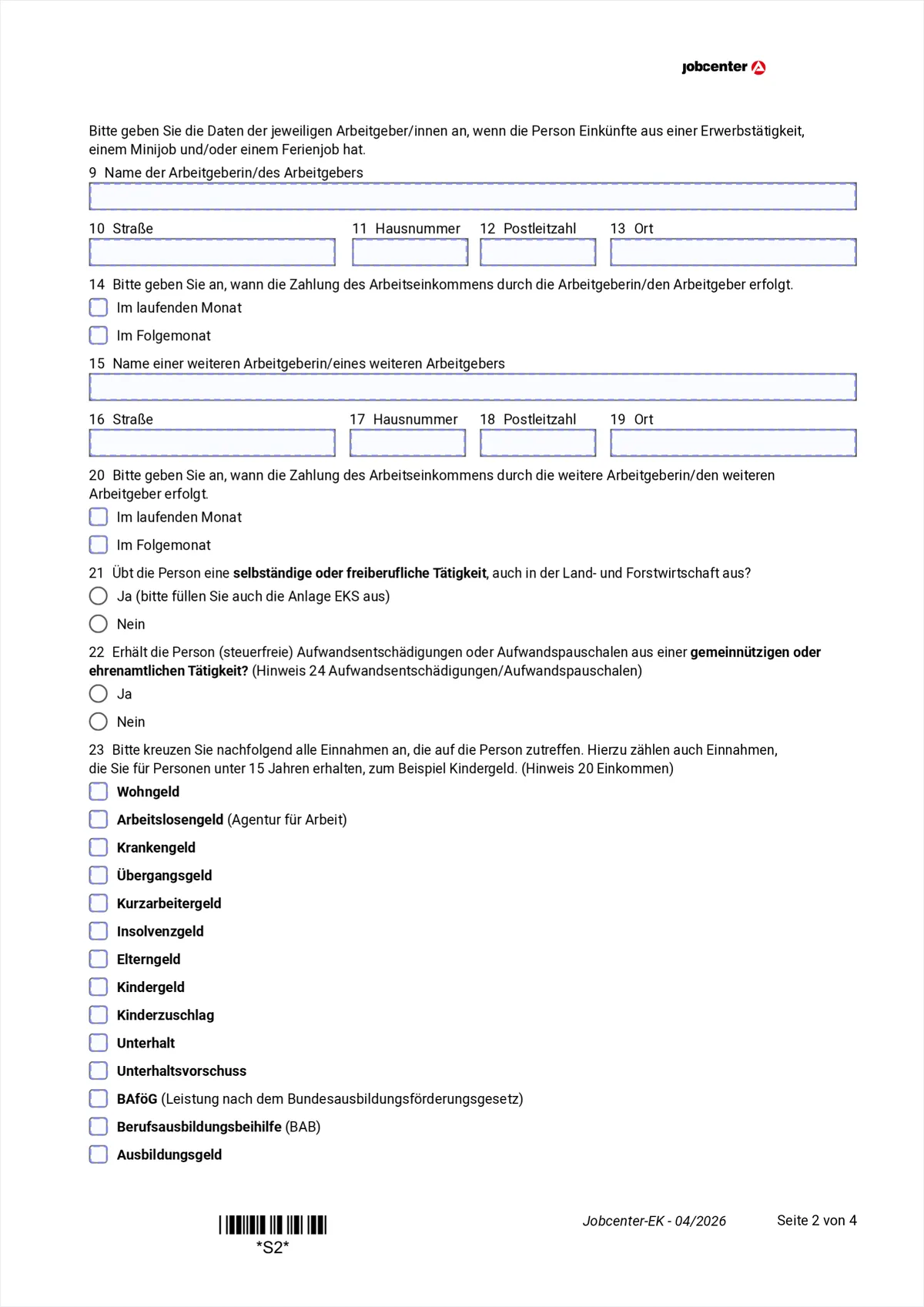
Hover or tap a marked field to see the explanation. Two identically built blocks for up to two employers at the top, the long tick list below. Important about items 14 and 20: the question is WHEN the money arrives, not how much. That determines the month the Jobcenter counts it in.
- 9
- Name of the employer, as in the employment contract or on the payslip.
- 10-13
- Address of the employer: street, house number, postcode, town.
- 14
- When the wage is paid: still in the current month or only in the following month. The following month is the normal case.
- 15-19
- The same block again for a second employer. With only one job it stays empty.
- 20
- Payment timing for the second job.
- 21
- Is the person self-employed or freelance, including in agriculture and forestry. If yes, the Anlage EKS comes on top, where income and expenses are broken down month by month.
- 22
- Does the person receive a tax-free expense allowance from voluntary or charitable work. Up to an allowance it is not counted, which is why it is asked separately.
- 23
- Tick list of all other income: Wohngeld, Arbeitslosengeld, Krankengeld, Übergangsgeld, Kurzarbeitergeld, Insolvenzgeld, Elterngeld, Kindergeld, Kinderzuschlag, maintenance, Unterhaltsvorschuss, BAföG, BAB, Ausbildungsgeld and more on the next page. Important: money you receive FOR a child under 15, such as Kindergeld, belongs here too.
3. Page 3: the rest of the income and the expenses that save money (items 24-34)
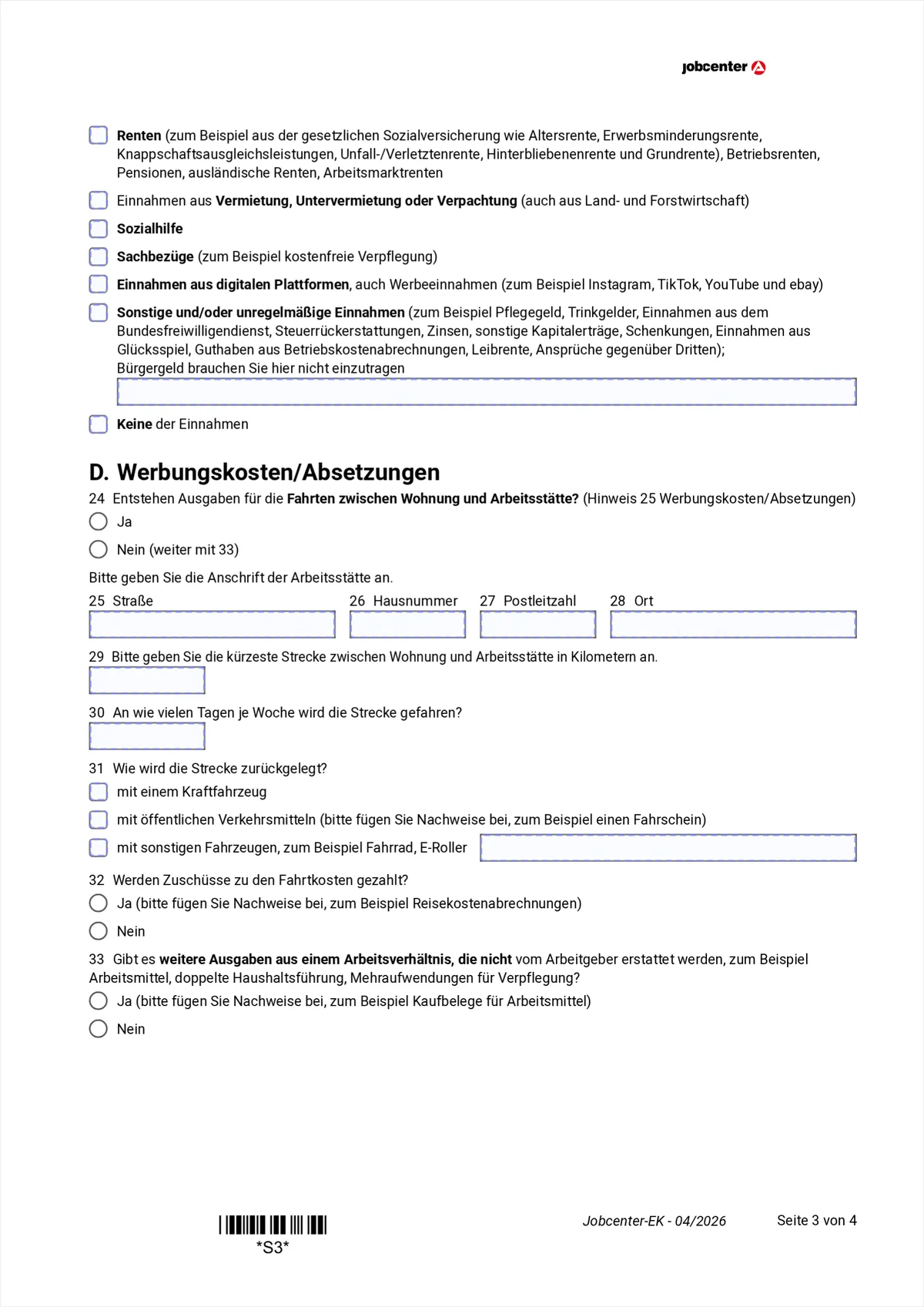
Hover or tap a marked field to see the explanation. The tick list ends at the top, section D begins below. That section is the most important part of the form for your wallet: everything listed there is DEDUCTED from the countable income. Fields left empty give money away.
- 23
- The list continues: pensions of every kind, including company and foreign pensions. Income from letting or leasing. Sozialhilfe. Payments in kind, that is benefits instead of money. Income from digital platforms including advertising revenue. Other and irregular income such as tips, tax refunds, interest or gifts. Right at the bottom: none of these. The Bürgergeld itself is NOT entered here.
- 24
- Do you have costs for the journey between home and workplace. If no, jump to item 33.
- 25-28
- Address of the workplace: street, house number, postcode, town. This means where you actually work, not the company's registered office.
- 29
- The shortest distance between home and workplace in kilometres, one way.
- 30
- How many days per week you travel that route.
- 31
- How you travel: your own vehicle, public transport, then attach a ticket, or another vehicle such as a bicycle or an e-scooter.
- 32
- Does the employer contribute to the travel costs, for example with a job ticket. If yes, attach evidence.
- 33
- Other work-related expenses nobody reimburses: work equipment, a second household at the workplace, extra costs for meals. Attach receipts.
- 34
- Tick the insurance contributions: motor third-party liability without comprehensive cover, other legally required insurance such as professional liability for lawyers or midwives, subsidised retirement provision under § 82 EStG such as the Riester-Rente, private insurance for children under 18. Attach evidence for every contribution.
Section D: what gets deducted
4. Page 4: children, maintenance and the signature (items 35-41)
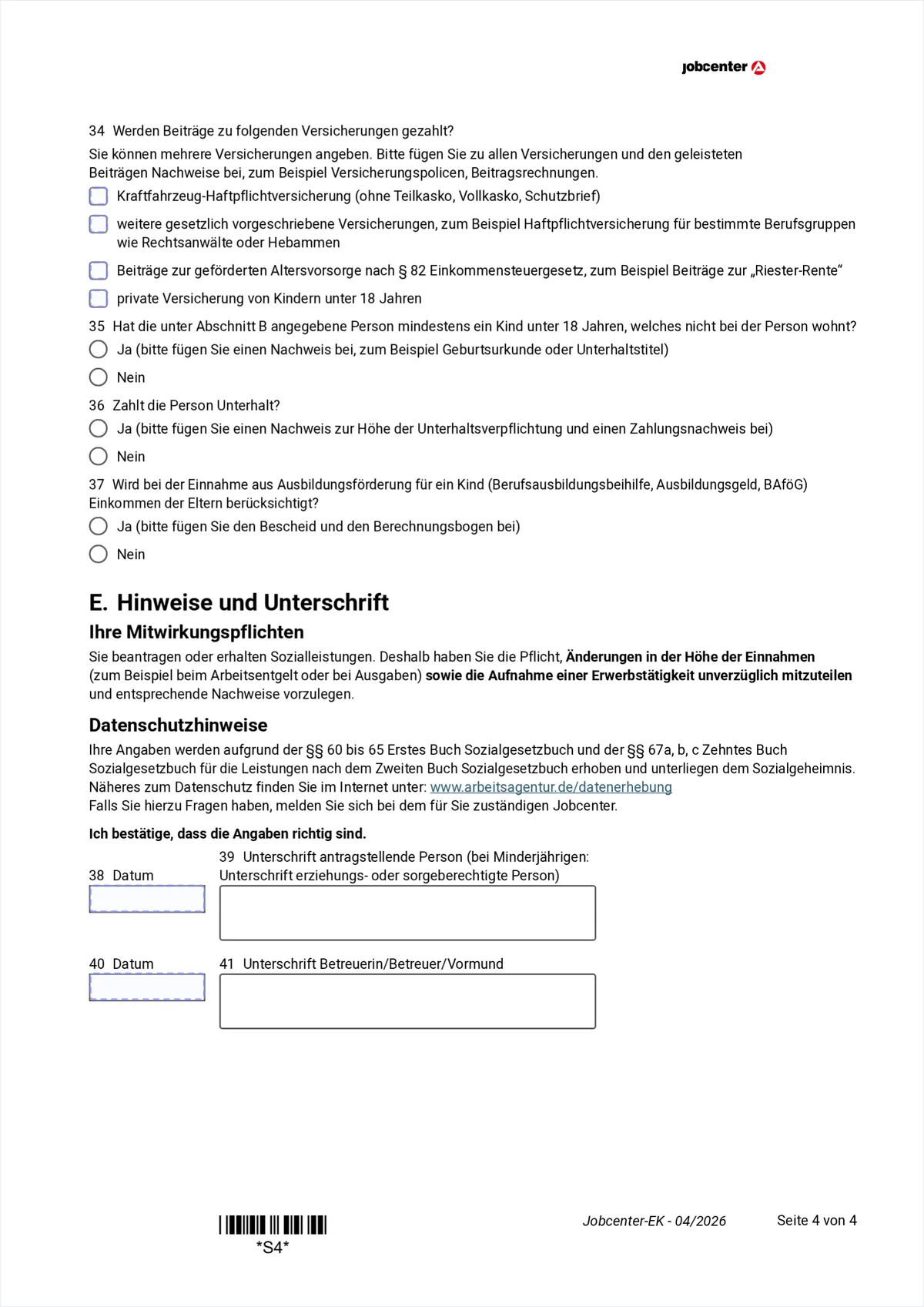
Hover or tap a marked field to see the explanation. Three short questions, then the signature. Item 36 looks like an obligation to report something, but it is a deduction too: maintenance you pay reduces the countable income.
- 35
- Does the person have at least one child under 18 who does NOT live with them. If yes, attach a birth certificate or a maintenance order.
- 36
- Does the person pay maintenance. If yes, attach evidence of the amount AND evidence of the payments.
- 37
- Is parental income taken into account for BAB, Ausbildungsgeld or BAföG for a child. If yes, attach the decision and the calculation sheet.
- 38-39
- Date and signature. For minors a parent or the legal guardian signs. Above it stand your duties: changes in income and taking up work must be reported immediately.
- 40-41
- Only with legal guardianship: date and signature of the guardian. Otherwise it stays empty.
Section E: obligations and signature
5. How to fill in the EK with explanations right on the form
Download the Anlage EK from jobcenter.digital or arbeitsagentur.de and open it in the free PDeF editor in your browser. The editor recognises the form automatically and marks the fields with dashed outlines: a click shows in plain language what belongs there. Because the EK is needed once per person, the template function helps especially here: reopen the same file and the editor restores your entries, so you only change the details of the person. You can sign via QR code with your phone, and the finished PDF downloads without a watermark. The file is not uploaded to a server: everything happens in your browser.
Tips
- Fill in one Anlage EK per person aged 15 and over with income, not one for the household.
- Section D is the part that pays: travel costs, work equipment and insurance contributions reduce the countable income, and empty lines there cost you money.
- Items 14 and 20 ask WHEN the money arrives, not how much. That decides the month the income is counted in.
- Sections A and B are two different people. On your own copy they are the same, which is exactly what confuses people.
Note, not legal advice: how exactly your income is counted and which allowances apply is calculated by the Jobcenter. If anything is unclear, the official filling instructions or a social advice centre can help.
Werbung
Frequently asked questions
Who needs an Anlage EK?
Every person aged 15 and over in the Bedarfsgemeinschaft, filled in individually. Section A is always the applicant, section B is the person the copy is about.
Do I have to enter Kindergeld here?
Yes. Money you receive for a child under 15, such as Kindergeld, belongs in item 23 of the copy for the person who receives it.
What counts as a deduction?
Travel costs between home and workplace, other work expenses such as work equipment, and insurance contributions including motor third-party liability and a Riester pension. All of them reduce the countable income.
The Bürgergeld itself, does it go in item 23?
No. The form says so explicitly: you do not enter the Bürgergeld here.
What evidence does the Jobcenter want?
For every income evidence showing both the kind and the arrival of the money, so typically a payslip together with the bank statement. For deductions, receipts and insurance policies.
Can I use the filled EK for the next person?
Yes. Reopen the saved file in the editor: your entries are restored and you only change section B with the next person's details.
Free, no account, nothing uploaded to a server
Fill a PDF now