Hauptantrag Bürgergeld: what every section of the form means
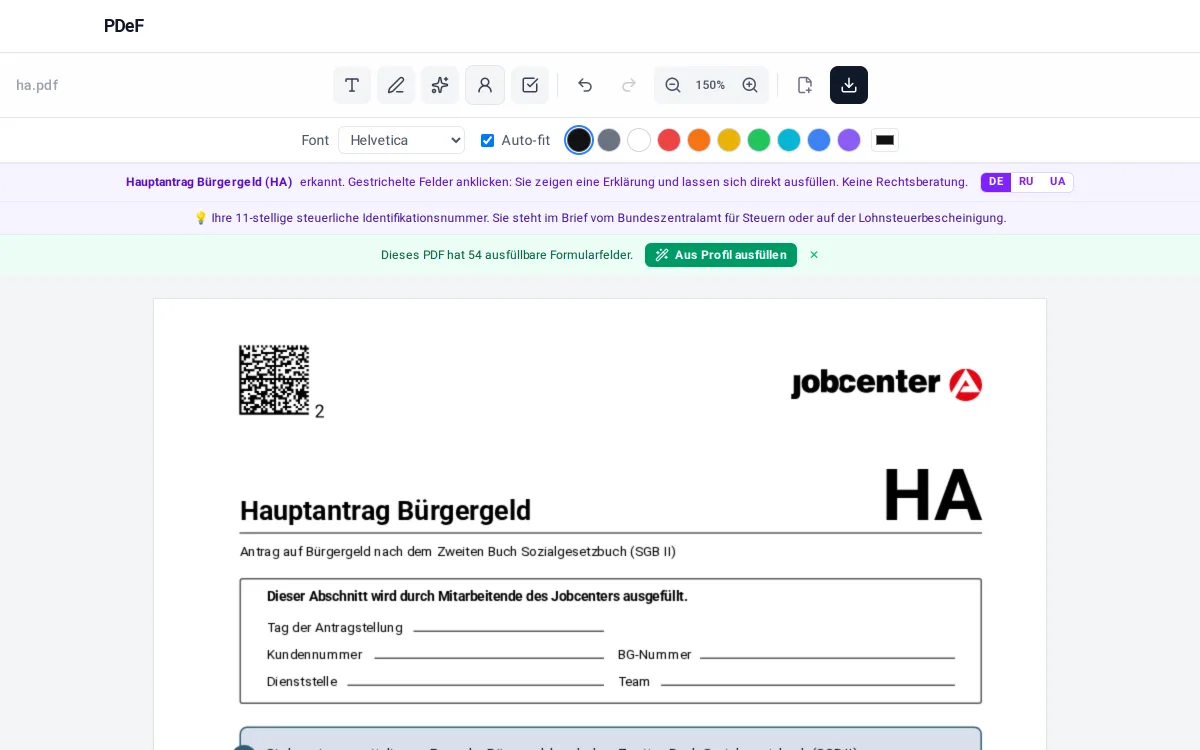
The Hauptantrag (HA for short) is the main form you use to apply for Bürgergeld at the Jobcenter for the first time: 8 pages, 85 numbered items. Even translated word for word, many phrasings stay unclear: what exactly is being asked, where a number or a date comes from, and which further documents („Anlage“) you have to attach depending on your situation. Below you see every page of the form and, underneath it, the explanation by item number: look at the page and you immediately see what goes where. The fields on the images are interactive: hover over a field or tap it and the explanation for exactly that field appears. You see the same explanations while filling it in: when you open the official HA, the PDeF editor labels every field with a plain-language hint.
1. Page 1: section A, who is applying (items 1-16)
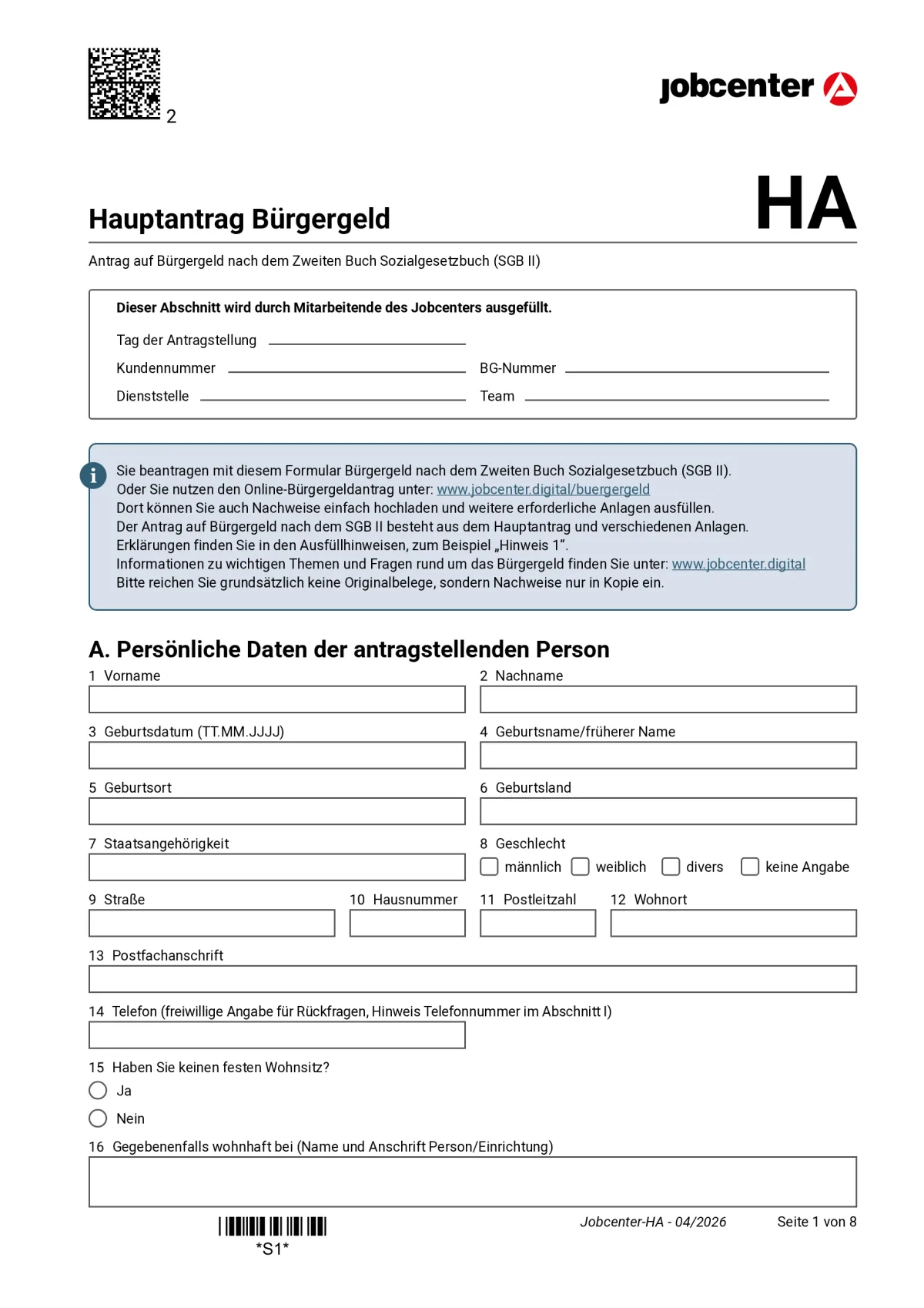
Hover or tap a marked field to see the explanation. Leave the grey box at the top alone, the Jobcenter fills that in. Your part starts with section A, the details about you personally.
- 1-2
- First name and surname, as in your ID.
- 3
- Date of birth in the format DD.MM.YYYY.
- 4
- Former surname, only if you changed it, for example before marriage. Otherwise leave it empty.
- 5-6
- Place and country of birth, as in your passport or birth certificate.
- 7
- Nationality as in your passport, for example ukrainisch.
- 8
- Sex, one tick: männlich male, weiblich female, divers other, keine Angabe not stated.
- 9-12
- Your current address: street, house number, postcode, town.
- 13
- PO box (Postfach). Empty for most people.
- 14
- Phone number, voluntary. If you leave it out, you are at no disadvantage.
- 15
- „Do you have no permanent home?“ Ja yes, Nein no.
- 16
- Only if you live with somebody or in an institution: the name and address of that person or organisation.
2. Page 2: bank details, personal numbers and section B (items 17-28)
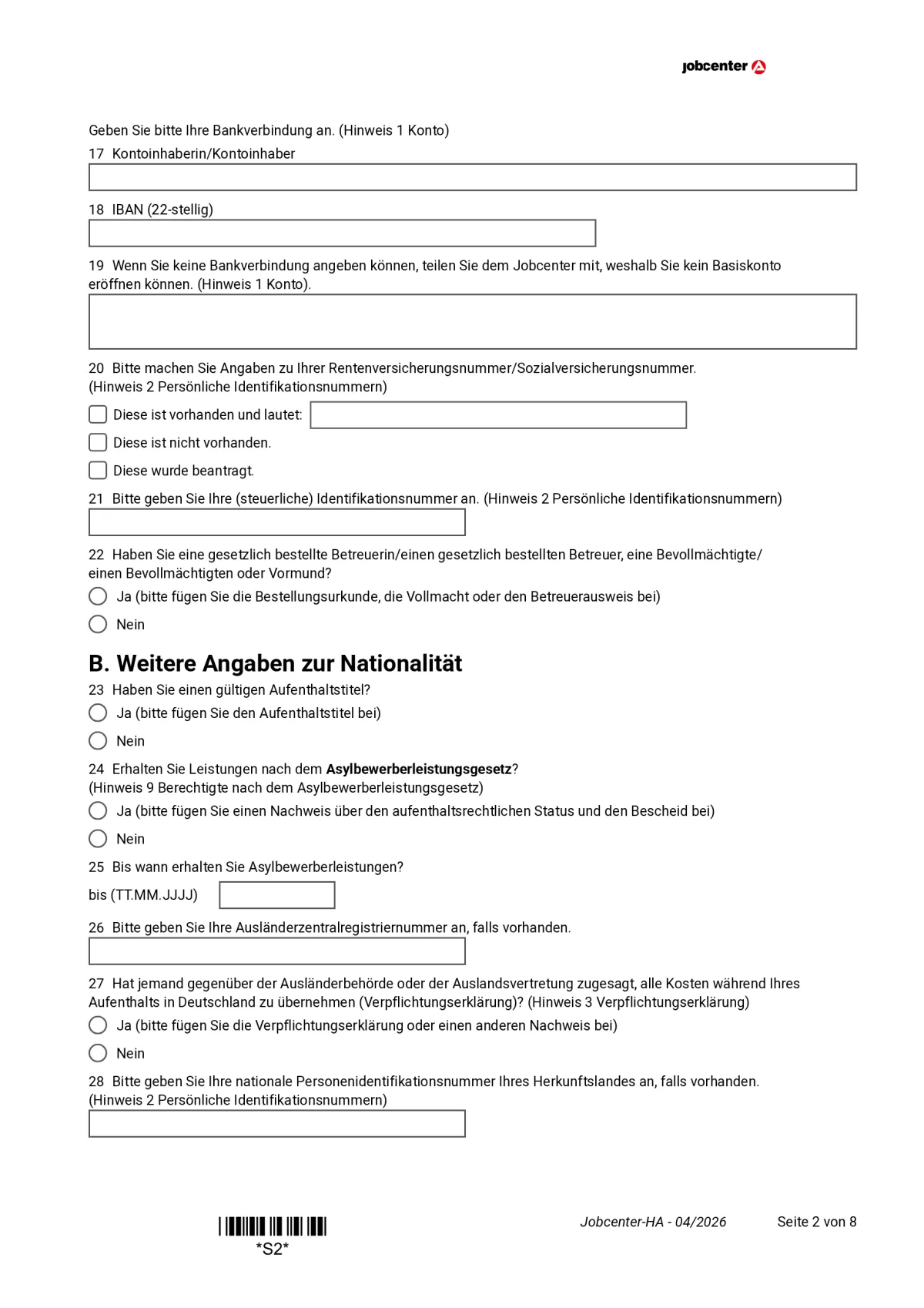
Hover or tap a marked field to see the explanation. The upper half is about where the money is transferred and which personal numbers you have. The lower half, section B, is about nationality and residence.
- 17
- Account holder, normally you yourself.
- 18
- IBAN, 22 characters, starting with DE. It is on your bank card or in your banking app.
- 19
- Only if you have no account: explain briefly why you cannot open a basic account (Basiskonto).
- 20
- Pension insurance number (Rentenversicherungsnummer). Tick one of the three options: it exists, then enter the number from the Sozialversicherungsausweis, it does not exist, or it has been applied for. Any answer is acceptable.
- 21
- Tax identification number, 11 digits, from the letter of the Bundeszentralamt für Steuern.
- 22
- Is there a legal guardian, an authorised representative or a wardship for you. If yes, attach the document.
- 23
- Do you have a valid residence permit (Aufenthaltstitel). If yes, attach a copy.
- 24-25
- Do you receive benefits under the Asylbewerberleistungsgesetz and until when. The date is in your decision.
- 26
- Foreigners' register number (AZR-Nummer), if you have one.
- 27
- Has anyone given a formal undertaking to cover your costs in Germany (Verpflichtungserklärung).
- 28
- Personal identification number of your country of origin, if there is one, for example from the national passport.
Section B: nationality and residence
3. Page 3: sections C and D, from when and your situation (items 29-40)
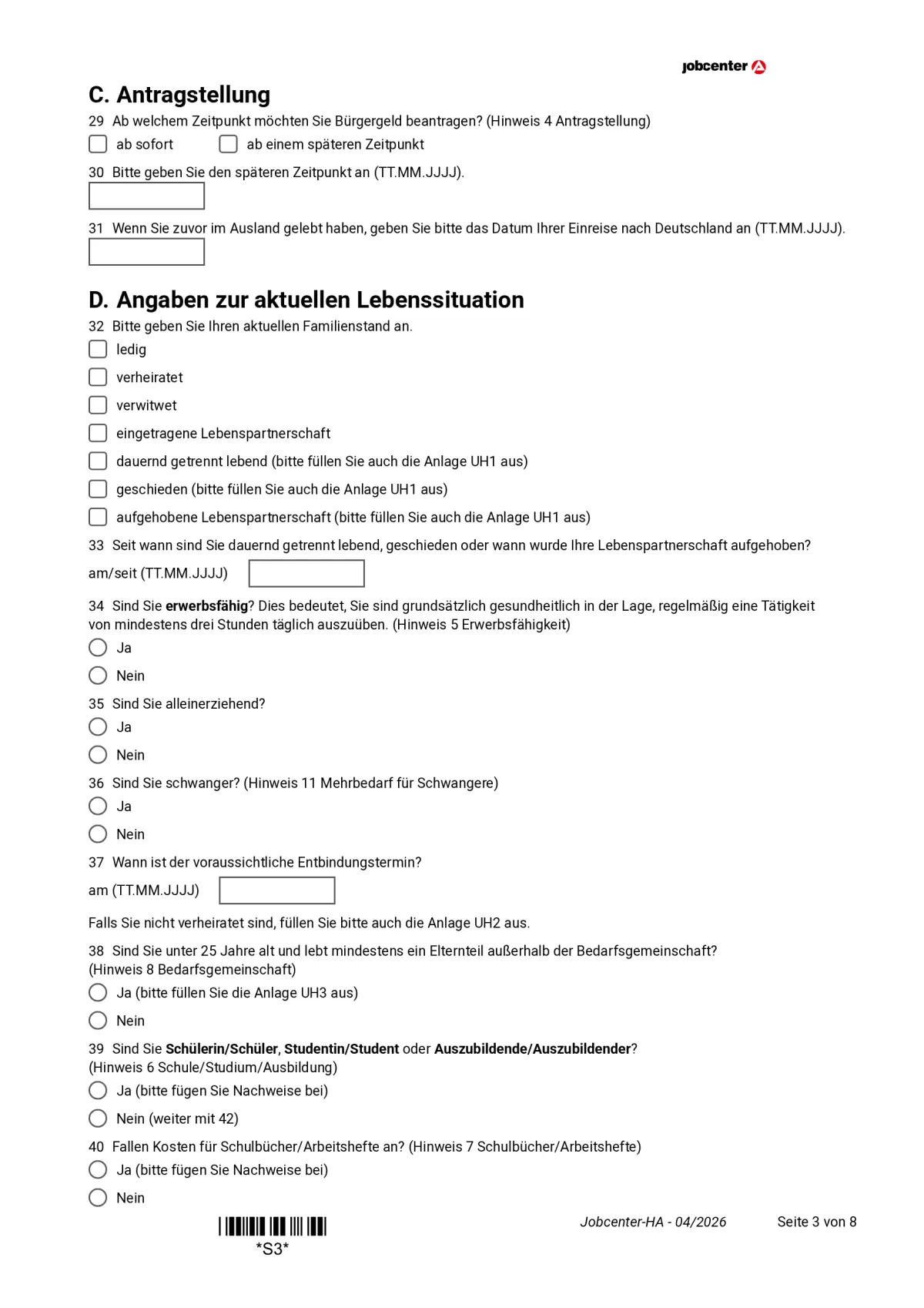
Hover or tap a marked field to see the explanation. Two short blocks: from when you need the benefit and what your life situation is. Several answers here pull in additional Anlagen.
- 29
- From when you need Bürgergeld: ab sofort immediately or ab einem späteren Zeitpunkt later.
- 30
- If later, enter the date.
- 31
- If you lived abroad before: the date you entered Germany.
- 32
- Marital status, one tick: ledig single, verheiratet married, verwitwet widowed, eingetragene Lebenspartnerschaft registered partnership, dauernd getrennt lebend permanently separated, geschieden divorced, aufgehobene Lebenspartnerschaft dissolved partnership. For any of the last three the Anlage UH1 is added.
- 33
- Since when you have been living apart, or since when the divorce applies.
- 34
- Erwerbsfähigkeit: are you medically able to work at least 3 hours a day. For most people the answer here is Ja.
- 35
- Are you raising a child on your own.
- 36-37
- Pregnancy and the expected date of birth from the Mutterpass. If you are not married, the Anlage UH2 is added.
- 38
- You are under 25 and at least one parent lives elsewhere. Ja additionally means the Anlage UH3.
- 39
- School, studies or an apprenticeship. If Nein, jump straight to item 42; if Ja, attach the certificate.
- 40
- Do you have costs for school books and exercise books.
Section C: from when
Section D: your situation
4. Page 4: other benefits and special needs (items 41-50)
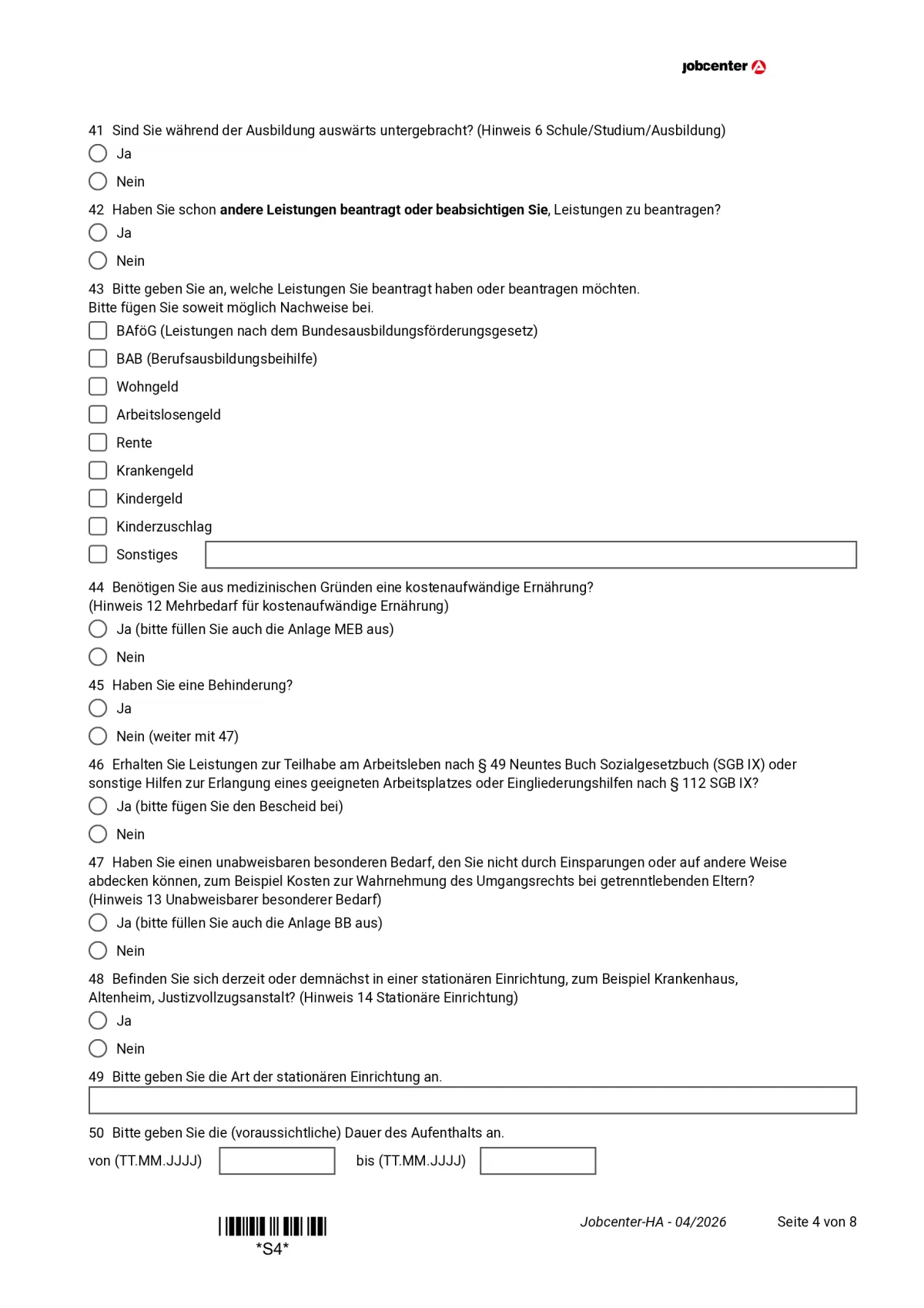
Hover or tap a marked field to see the explanation. Here the Jobcenter checks whether part of your need is already covered by other benefits and whether you have special expenses.
- 41
- Do you live away from home during your training.
- 42
- Have you applied for other benefits or do you intend to.
- 43
- Tick which ones: BAföG, BAB training support, Wohngeld housing benefit, Arbeitslosengeld unemployment benefit, Rente pension, Krankengeld sick pay, Kindergeld child benefit, Kinderzuschlag child supplement, Sonstiges other, which you have to write in. The question is about applications filed, not about amounts already received.
- 44
- Do you need a special, more expensive diet for medical reasons. Ja additionally means the Anlage MEB.
- 45
- Do you have a disability. If Nein, jump straight to item 47.
- 46
- Do you receive benefits for participation in working life under SGB IX. If Ja, attach the decision.
- 47
- Is there an unavoidable special need you cannot cover otherwise, for example costs for contact with your child when parents live apart. Ja additionally means the Anlage BB.
- 48-50
- Are you currently or soon in a stationary facility (hospital, care home, prison): the type of facility and the period from and to.
5. Page 5: section E, what you lived on before (items 51-70)
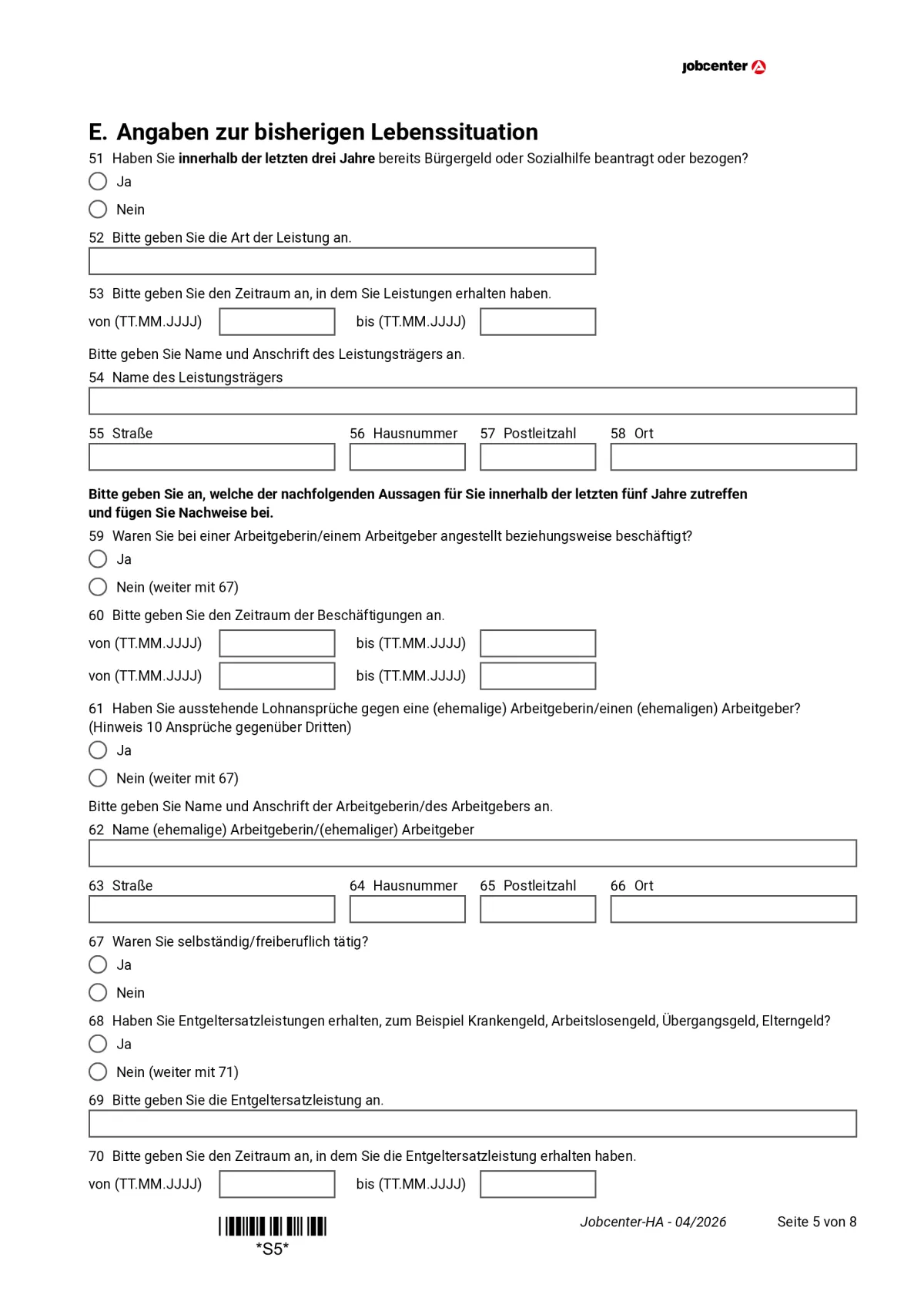
Hover or tap a marked field to see the explanation. Section E asks about your history: first earlier benefits in the last 3 years, then work and income in the last 5 years. Attach evidence for every Ja.
- 51
- Have you applied for or received Bürgergeld or Sozialhilfe in the last 3 years.
- 52-53
- Which benefit exactly and for which period.
- 54-58
- Name and full address of the former authority. All of it is printed at the top of the old decision letter.
- 59
- Were you employed. If Nein, jump straight to item 67.
- 60
- Periods of employment, there are two lines for two jobs.
- 61
- Does a former employer still owe you wages. If Nein, continue with item 67.
- 62-66
- Name and address of the employer, from the employment contract or a payslip.
- 67
- Were you self-employed or freelance.
- 68
- Have you received wage replacement benefits (Entgeltersatzleistungen): Krankengeld, Arbeitslosengeld, Übergangsgeld, Elterngeld. If Nein, continue with item 71.
- 69-70
- Which one exactly and for which period.
6. Page 6: end of section E, insurance and start of section G (items 71-80)
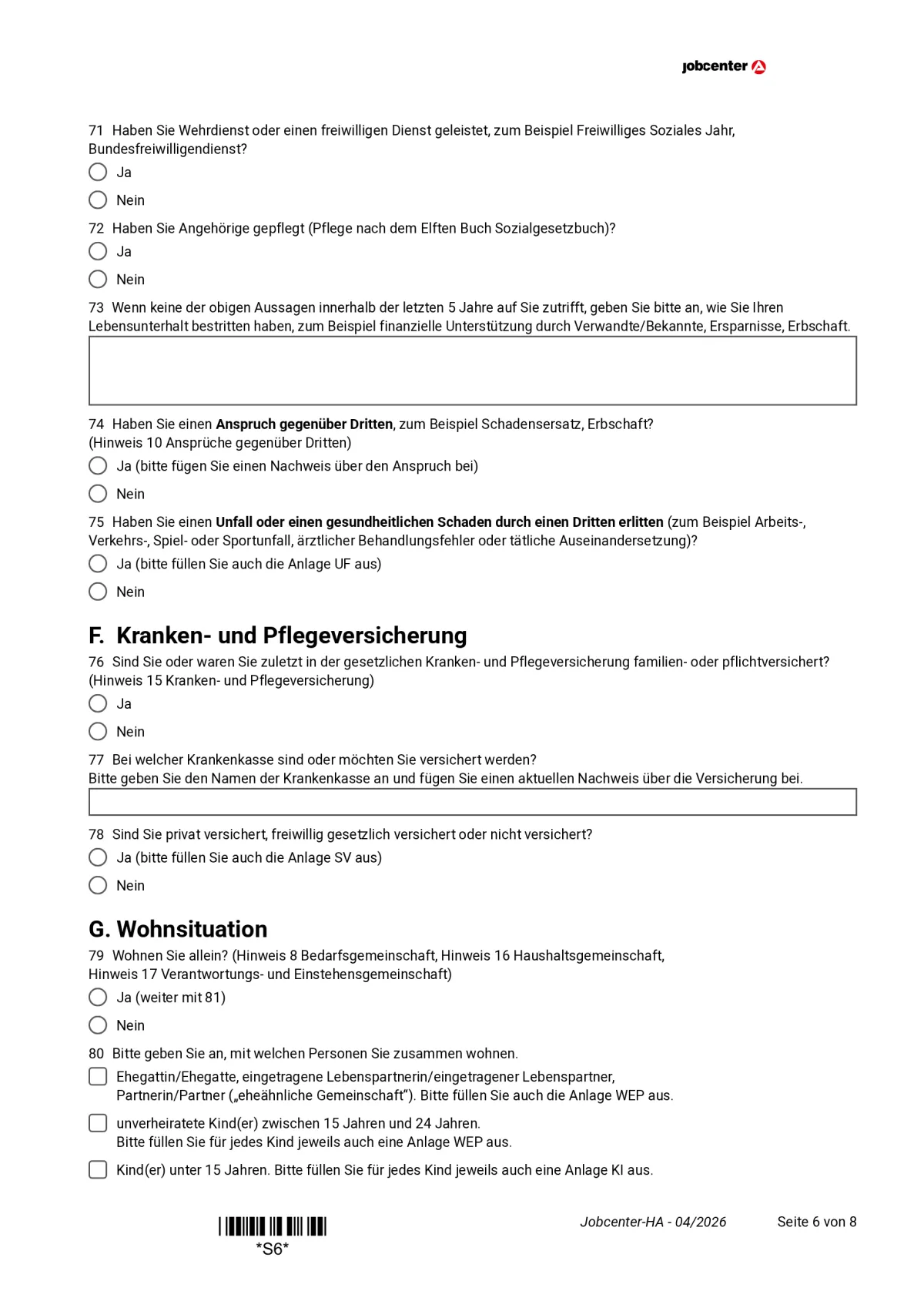
Hover or tap a marked field to see the explanation. This is where the questions about the last 5 years end, followed by health insurance and the question of who you live with.
- 71
- Have you done military service or a voluntary year (FSJ, Bundesfreiwilligendienst).
- 72
- Have you cared for relatives (Pflege).
- 73
- If none of the questions about the last 5 years applies: describe in your own words what you lived on, for example savings, help from relatives, an inheritance.
- 74
- Do you have money claims against others, for example damages or an inheritance.
- 75
- Were you harmed by an accident or by another person. Ja additionally means the Anlage UF.
- 76
- Were you covered by the statutory (gesetzlich) health insurance.
- 77
- The name of your health insurer, for example TK, AOK, Barmer. Attach a current confirmation.
- 78
- Private or voluntary insurance. Ja additionally means the Anlage SV.
- 79
- Do you live alone. If Ja, jump straight to item 81.
- 80
- Tick who you live with. A spouse or partner means the Anlage WEP. Unmarried children aged 15 to 24: Anlage WEP per child. Children under 15: Anlage KI per child.
Section F: health insurance
Section G: who you live with
7. Page 7: housing costs and the list of all Anlagen (item 81, sections H and I)
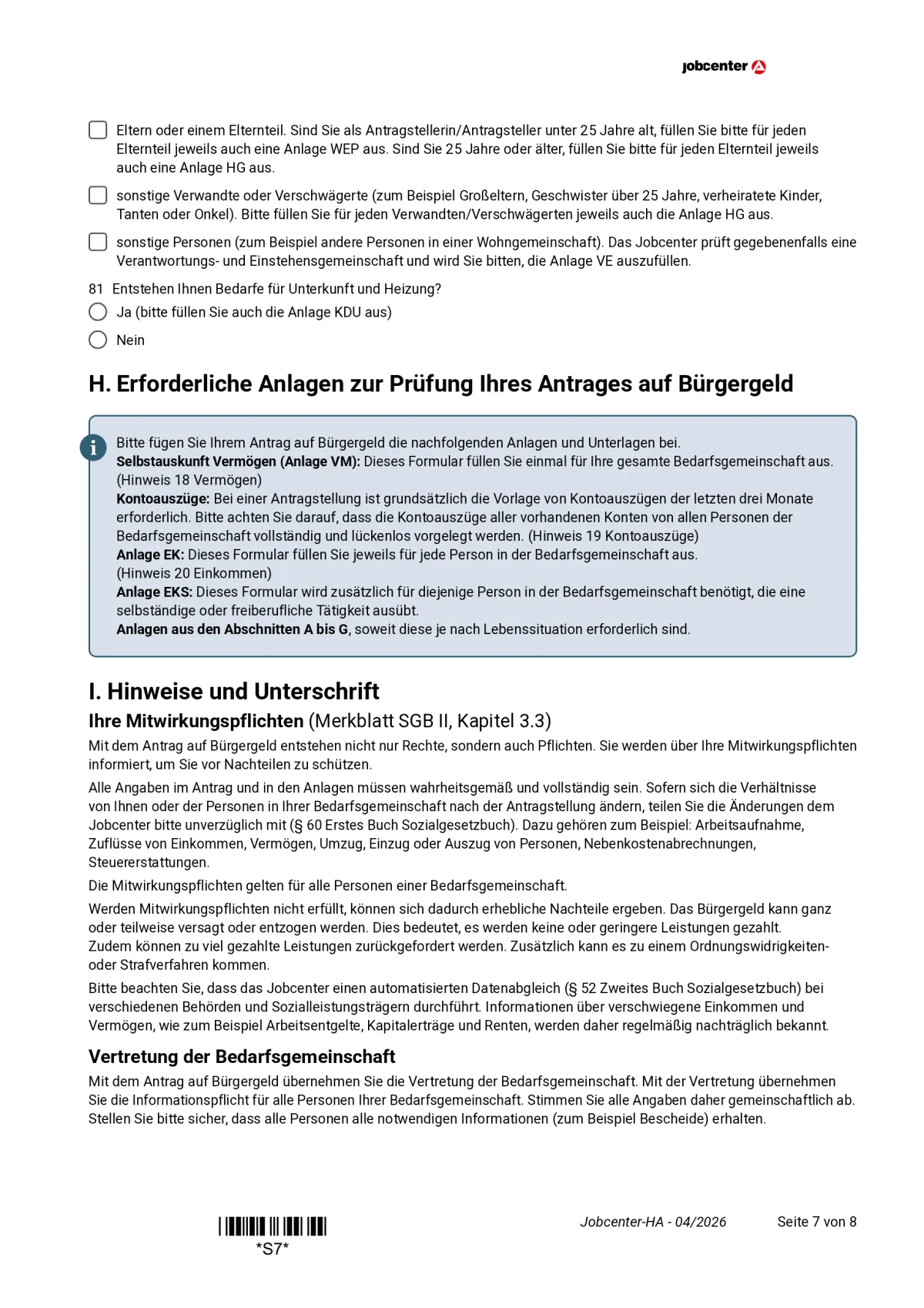
Hover or tap a marked field to see the explanation. The list from item 80 continues at the top, then one question about housing. The lower half of the page is not a fill-in area but a ready-made checklist of Anlagen and the text about your duties.
- 80
- Continuation of the list. Living with parents: under 25 an Anlage WEP per parent, from 25 an Anlage HG. Other relatives such as grandparents or siblings over 25: Anlage HG each. Other people such as flatmates: the Jobcenter will ask for the Anlage VE if needed.
- 81
- Do you have costs for accommodation and heating. For almost everybody this is Ja, and then the Anlage KDU is added.
- VM
- Anlage VM on assets, once for the whole Bedarfsgemeinschaft.
- Konto
- Bank statements of every account of every member for the last 3 months, complete and without gaps.
- EK
- Anlage EK on income, one per person.
- EKS
- Anlage EKS on top if anyone is self-employed.
- I
- All details have to be true and complete. Changes (work, income, moving, new people in the household) must be reported to the Jobcenter immediately. By applying you represent your whole Bedarfsgemeinschaft.
Section H: what to attach
Section I: your duties
8. Page 8: signature (items 82-85)
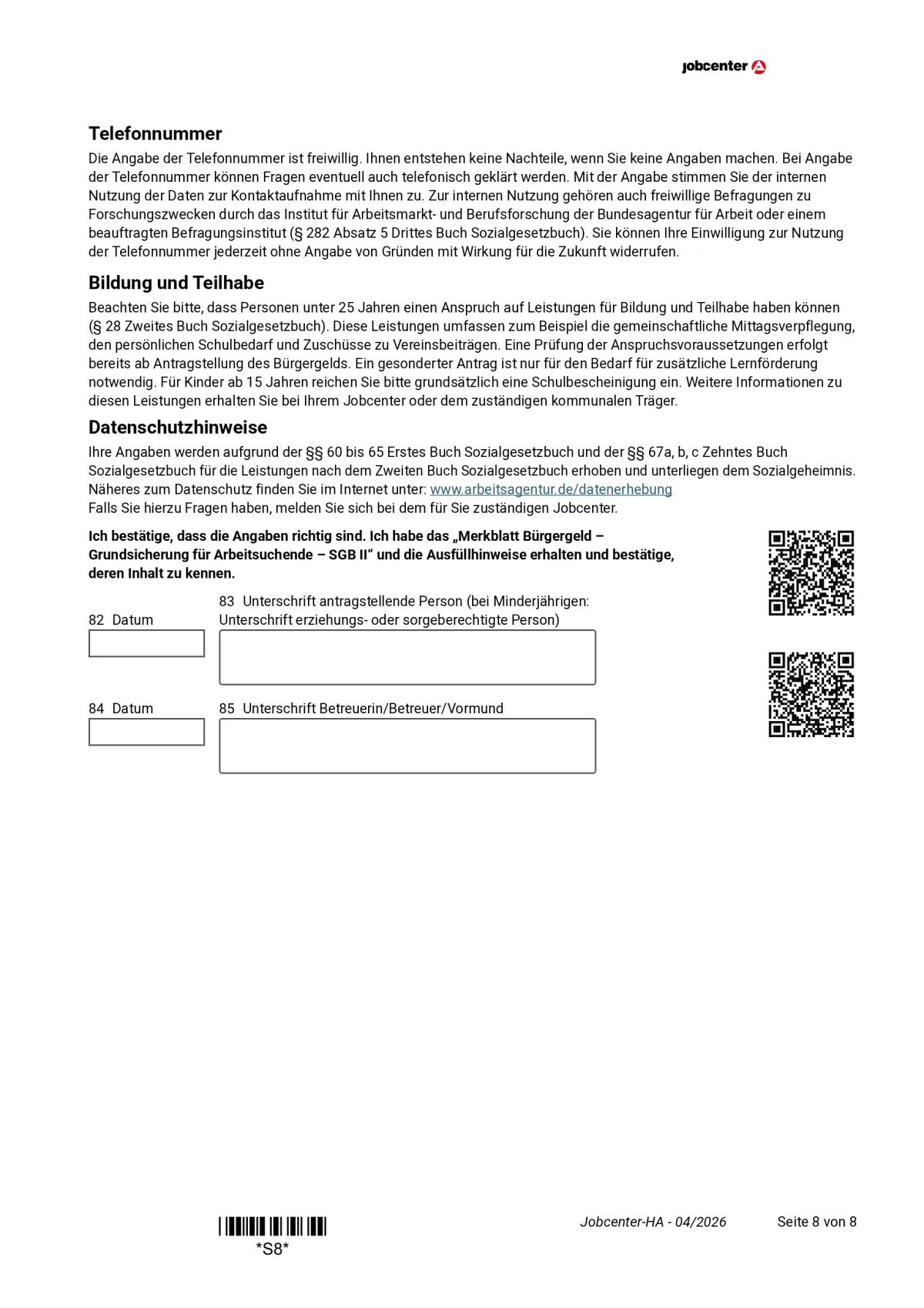
Hover or tap a marked field to see the explanation. Three information blocks at the top: the phone number is voluntary; people under 25 can receive benefits for education and participation (Bildung und Teilhabe), that is school meals, school supplies and club fees; the data protection note explains on what legal basis your data is processed. The bold line above the signature means: you confirm that your details are correct and that you have received and read the Merkblatt Bürgergeld and the filling instructions.
- 82
- Date of signature.
- 83
- Your signature. For minors a parent or the legal guardian signs.
- 84-85
- Only with legal guardianship: date and signature of the guardian. For everybody else it stays empty.
9. How to fill all this in with explanations right on the form
Download the official HA form from jobcenter.digital or arbeitsagentur.de and open it in the free PDeF editor in your browser. The editor recognises the form automatically and marks the fields with dashed outlines: clicking a field shows what belongs in it and where to find the data, exactly the explanations you read above, only right on the line in question. Recurring details (name, address, IBAN) are pulled in with one click from the local profile, you can sign via QR code with your phone, and the finished PDF downloads without a watermark. The file is not uploaded to a server: everything happens in your browser.
Tips
- The application is backdated to the first of the month it is filed in: better to submit it incomplete and hand in evidence later than to wait and lose weeks of payment.
- Bank statements of every account for the last three months are needed almost always with this application; get them ready in advance.
- If documents are missing (an employment contract, an old decision), first fill in what you know for certain and add the figures and dates once you have found the papers.
- A field that does not concern you stays empty: an invented entry is worse than an empty line the Jobcenter can ask about.
Note, not legal advice: whether Bürgergeld is granted and at what level is decided by your Jobcenter alone. For questions about entitlement, the filling instructions of the Bundesagentur für Arbeit or a social advice centre can help.
Werbung
Frequently asked questions
Which documents do I need for the Hauptantrag?
ID or passport, tenancy agreement, bank statements of the last three months, evidence of income and health insurance. Section H of the form lists the required Anlagen.
Can I also apply online?
Yes, there is an online application at jobcenter.digital. The PDF form is the alternative if you prefer working with the file or want to fill it in calmly in advance.
I do not understand a field, what should I do?
In the PDeF editor click the dashed field: a plain-language explanation shows what is meant and where the detail is, in German, Russian or Ukrainian.
From when is Bürgergeld paid?
The application is backdated to the first of the month it is filed in. So what counts is the date it arrives at the Jobcenter, not its completeness.
Can I save the form and finish it later?
Yes. Download the PDF in between; when you reopen it in the editor it recognises the form and offers to restore your entries. That way you can work through the 8 pages in stages.
Can I move a field if it does not sit exactly right?
Yes. Every field can be clicked after placing and then moved pixel by pixel, resized or deleted. That is handy with tightly printed form lines.
Free, no account, nothing uploaded to a server
Fill a PDF now