Anlage WEP: what belongs in every item of the form
The Anlage WEP describes another person aged 15 or over in your Bedarfsgemeinschaft: 7 pages, 75 numbered items, the longest Anlage of the whole family. At its core it asks the same questions as the Hauptantrag, only about somebody else: a partner, an adult child, and for applicants under 25 also the parents. For children under 15 you use the Anlage KI instead, and for people in the household outside the Bedarfsgemeinschaft the Anlage HG. This guide walks through the form page by page: above you see the original page, below it what belongs in each item. The fields on the images are interactive: hover over them or tap them. You see the same explanations while filling it in the PDeF editor, in German, Russian and Ukrainian.
1. Page 1: two people and the switch in item 13 (items 1-13)
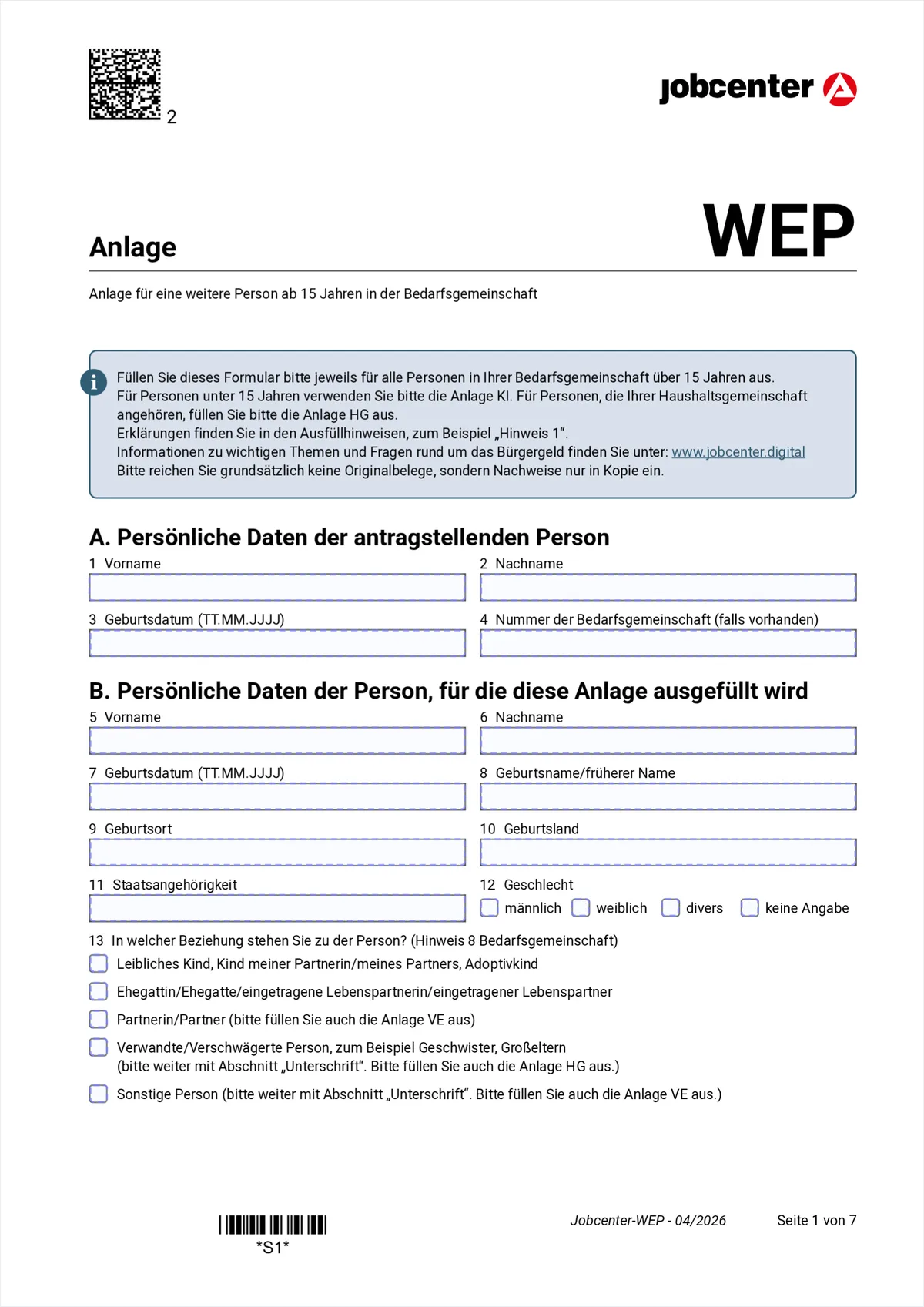
Hover or tap a marked field to see the explanation. As in the Anlage EK it is about TWO people: section A is the applicant, section B is the person this copy is about. Item 13 then decides whether you fill in the whole form or jump straight to the signature after it.
- 1-3
- First name, surname and date of birth of the applicant, that is the person who signs the Hauptantrag.
- 4
- Bedarfsgemeinschaft number, if you have one. It is printed at the top of every letter from the Jobcenter. Leave it empty on a first application.
- 5-7
- First name, surname and date of birth of the other person.
- 8
- That person's former name, only if the name was changed, for example before marriage.
- 9-11
- Place of birth, country of birth and nationality, as in the passport.
- 12
- Sex, one tick: männlich, weiblich, divers or keine Angabe.
- 13
- The most important question in the form: how the person is related to you. A child, a spouse and a registered partnership fill in the whole form. An unmarried partner additionally fills in the Anlage VE. Relatives such as siblings or grandparents, and other people, jump straight to the signature and need the Anlage HG or VE instead.
Section A: who is applying
Section B: who this is about
2. Page 2: numbers, residence and marital status (items 14-24)
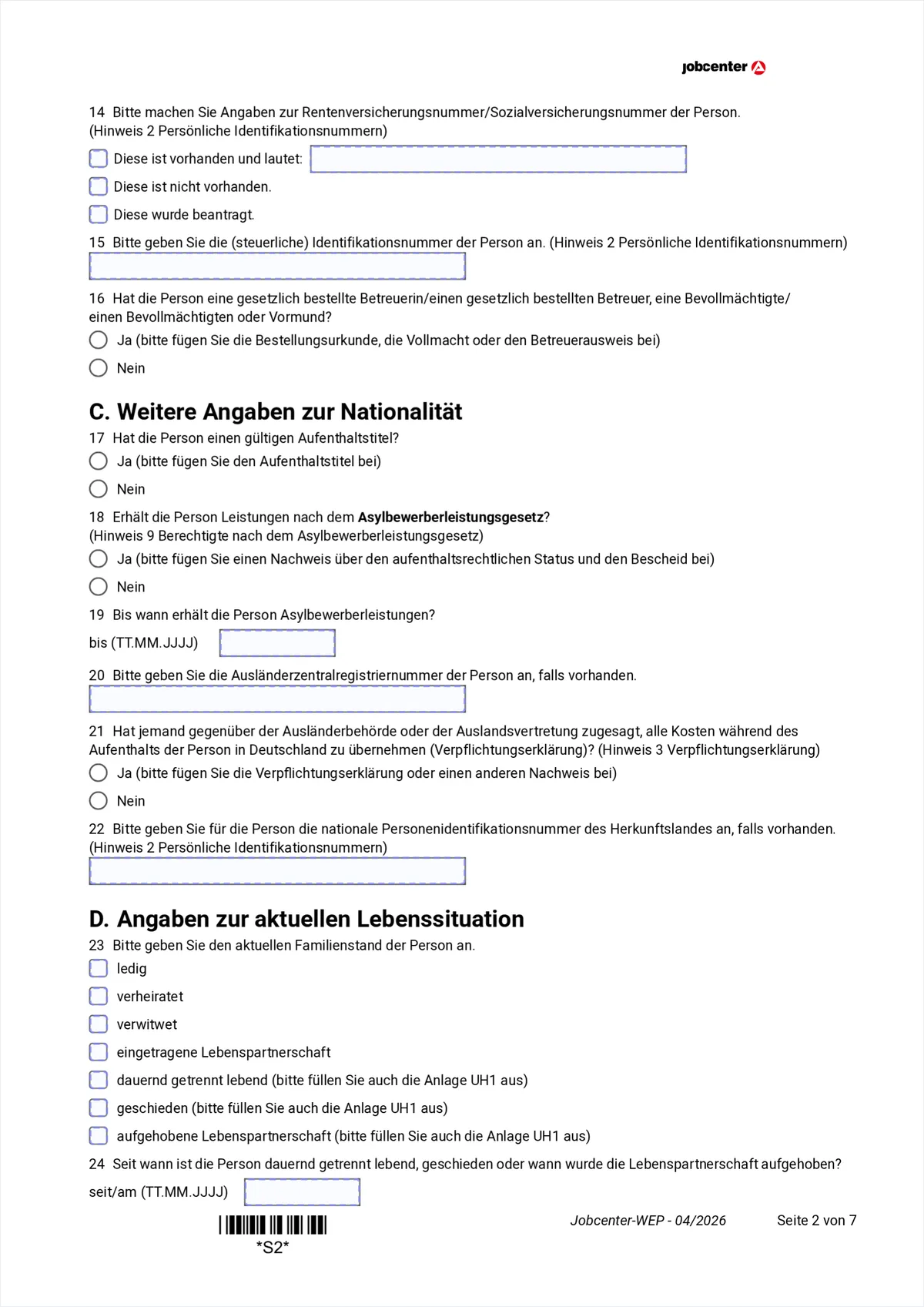
Hover or tap a marked field to see the explanation. The same details the Hauptantrag asks about you, now about this person. If you have already filled in the HA, the whole page will look familiar.
- 14
- The person's pension insurance number: tick one of the three options, exists with the number from the Sozialversicherungsausweis, does not exist, or has been applied for.
- 15
- The person's tax identification number, 11 digits, from the letter of the Bundeszentralamt für Steuern.
- 16
- Is there a legal guardianship, power of attorney or wardship for this person. If yes, attach the evidence.
- 17
- Does the person have a valid residence permit. If yes, attach a copy.
- 18-19
- Does the person receive benefits under the Asylbewerberleistungsgesetz and until when. The date is in the decision.
- 20
- The person's foreigners' register number (AZR-Nummer), if there is one.
- 21
- Has anyone given a formal undertaking to cover this person's costs.
- 22
- National personal identification number of the country of origin, if there is one.
- 23
- The person's marital status, one tick. Permanently separated, divorced and a dissolved partnership each pull in the Anlage UH1.
- 24
- Since when the separation or divorce applies.
Section C: nationality and residence
Section D: living situation
3. Page 3: health, school and other benefits (items 25-34)
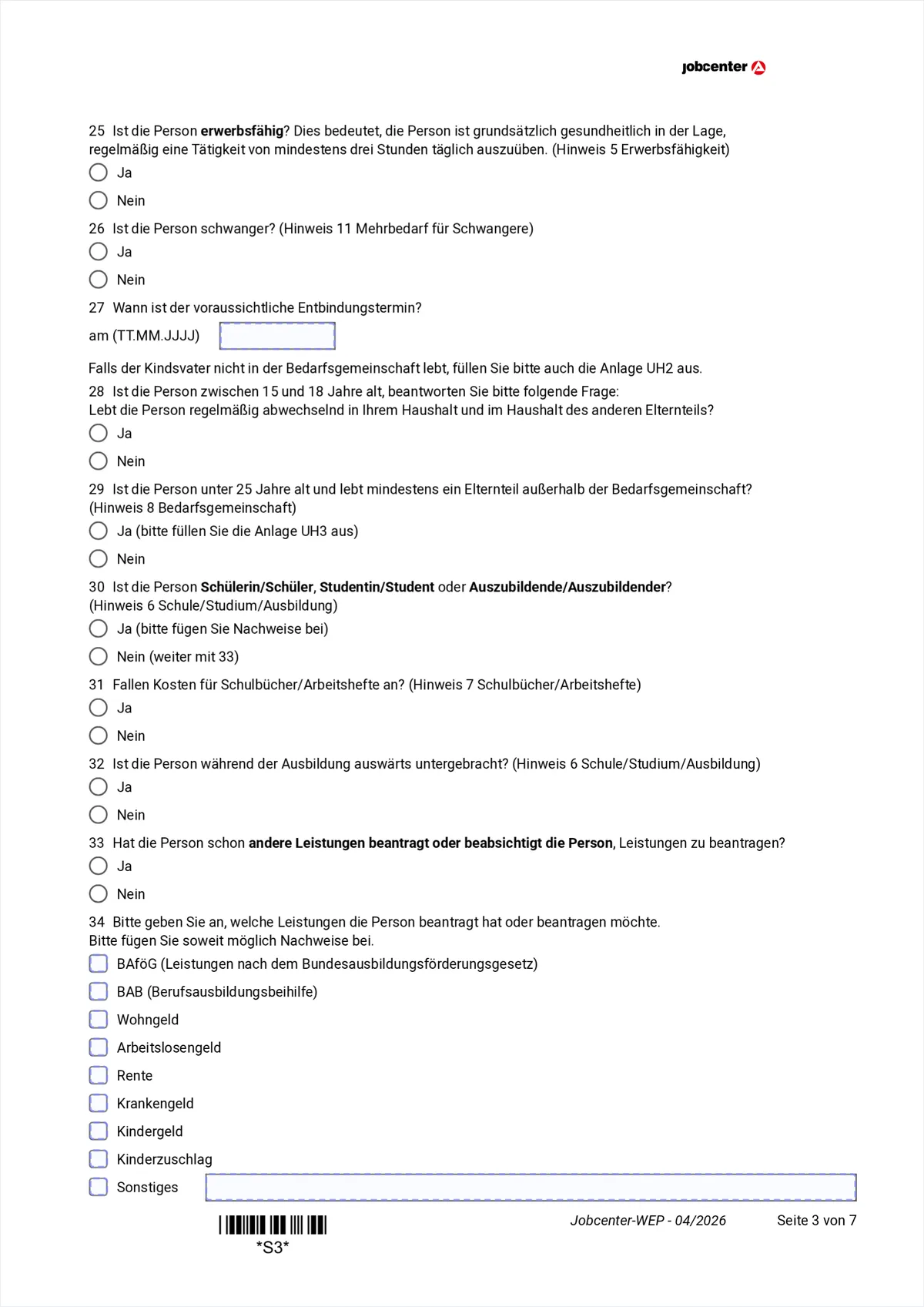
Hover or tap a marked field to see the explanation. Item 28 exists only in the WEP, not in the Hauptantrag: it concerns teenagers between 15 and 18 who live with both parents in turn. That decides how the need is split between the two households.
- 25
- Is the person employable, that is medically able to work at least 3 hours a day. For most people this is yes.
- 26-27
- Pregnancy and the expected date of birth from the Mutterpass. If the father is not in the Bedarfsgemeinschaft, the Anlage UH2 comes on top.
- 28
- Only for 15- to 18-year-olds: does the person live alternately in your household and in the other parent's household.
- 29
- Is the person under 25 with at least one parent living outside the Bedarfsgemeinschaft. If yes, the Anlage UH3 comes on top.
- 30
- School, studies or an apprenticeship. If no, jump to item 33; if yes, attach the certificate.
- 31-32
- Costs for school books and exercise books, and whether the person lives away from home during training.
- 33
- Has the person applied for other benefits or does it intend to.
- 34
- Tick which ones: BAföG, BAB, Wohngeld, Arbeitslosengeld, Rente, Krankengeld, Kindergeld, Kinderzuschlag or something else. The question is about applications, not amounts received.
4. Page 4: extra allowances and the look back (items 35-46)
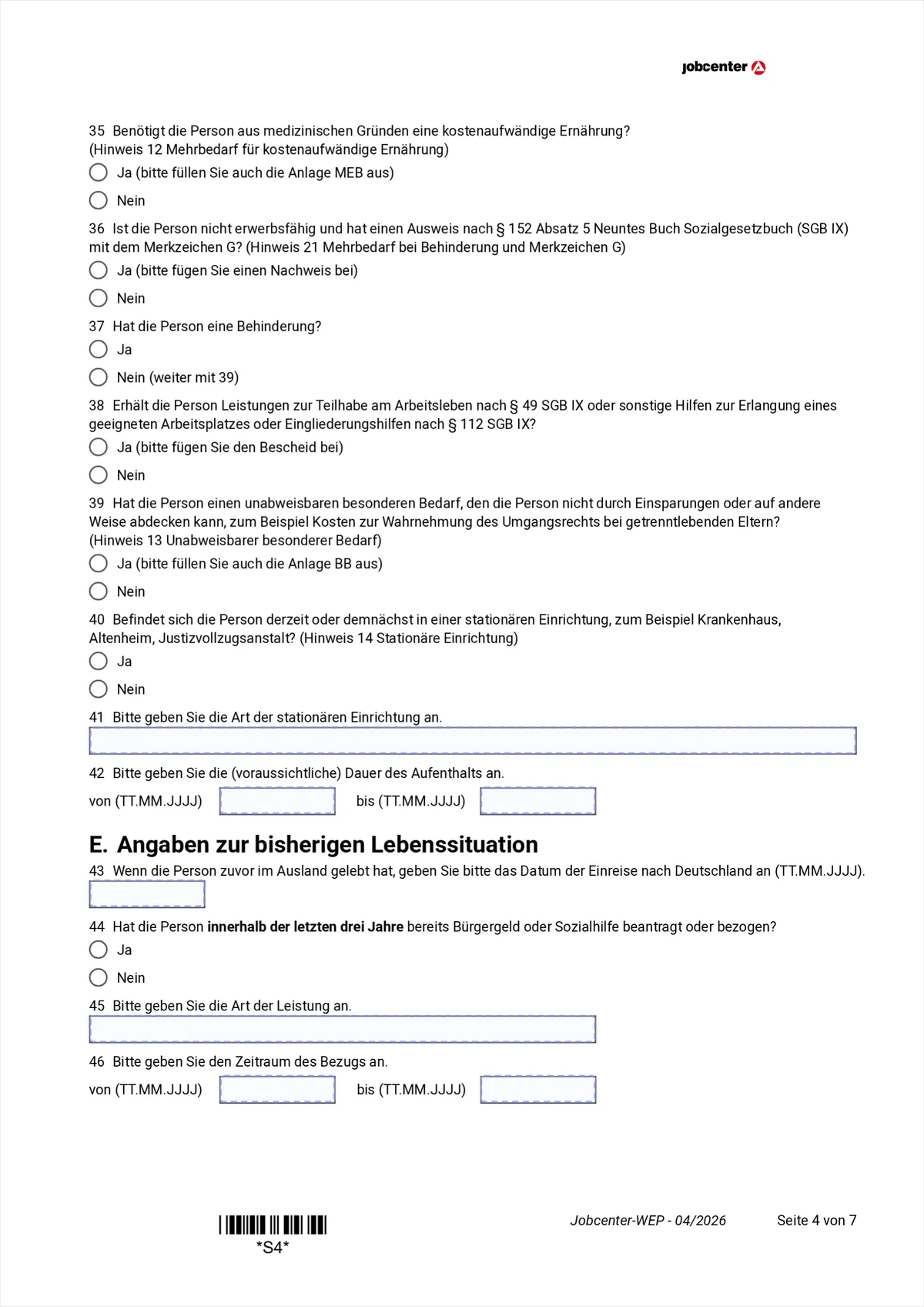
Hover or tap a marked field to see the explanation. The upper half collects Mehrbedarfe, that is supplements on top of the standard rate. Item 36 is overlooked most often, and it is real money.
- 35
- Does the person need a costly diet for medical reasons. If yes, the Anlage MEB comes on top.
- 36
- Is the person NOT employable and at the same time holds a severe disability pass with the mark G. Only both together trigger their own extra allowance, so attach evidence.
- 37-38
- Is there a disability, if no continue with 39. Does the person receive benefits for participation in working life under SGB IX, then attach the decision.
- 39
- An unavoidable special need, for example costs for contact with a child when parents live apart. If yes, the Anlage BB comes on top.
- 40-42
- Is the person currently or soon in a stationary facility, plus the type of facility and the period.
- 43
- If the person lived abroad before: the date of entry into Germany.
- 44
- Has the person applied for or received Bürgergeld or Sozialhilfe in the last 3 years.
- 45-46
- Which benefit exactly and for which period.
Section E: the previous situation
5. Page 5: work and income of the last five years (items 47-65)
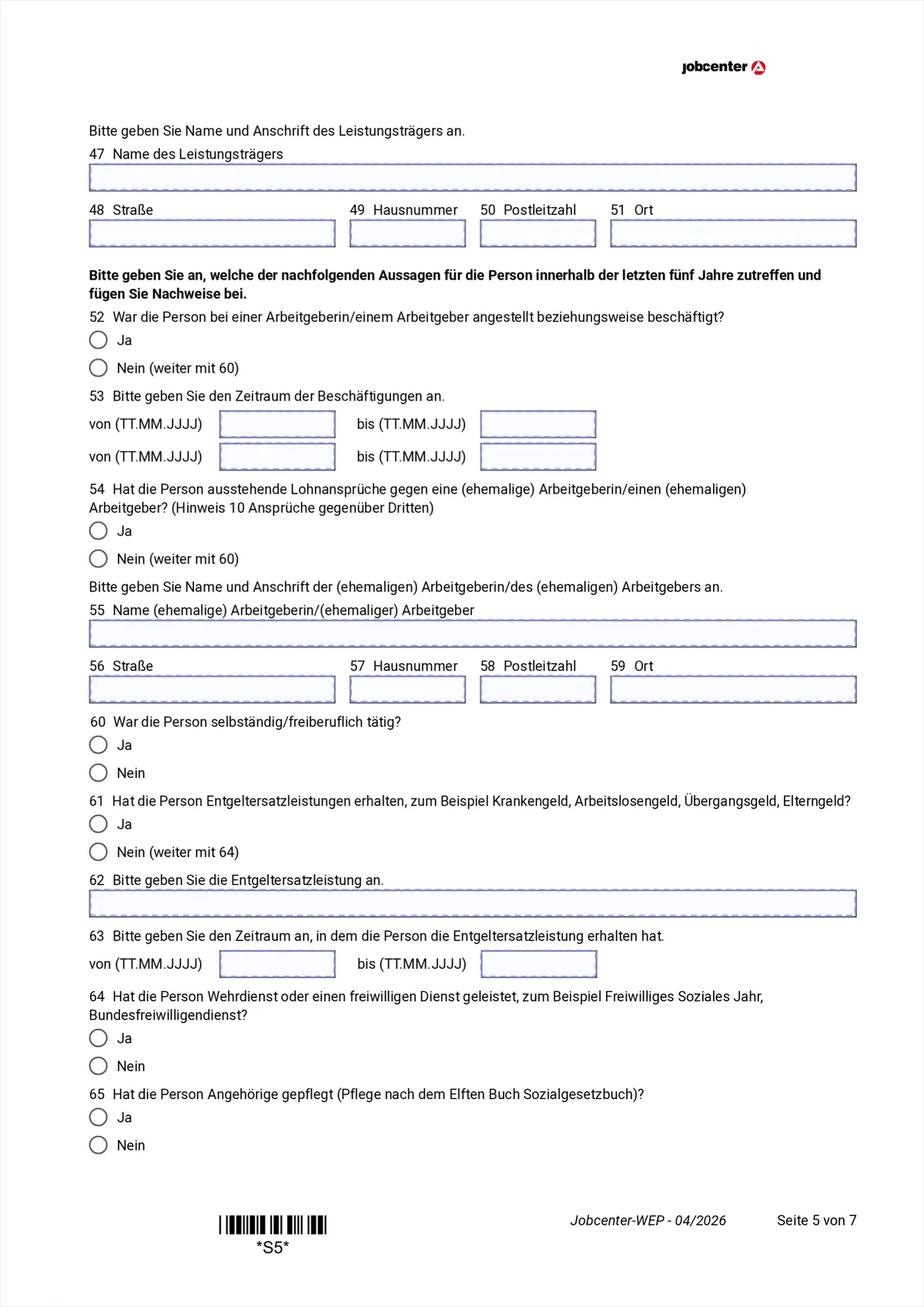
Hover or tap a marked field to see the explanation. The densest page of the form, but with plenty of jumps: three of the questions lead straight on when answered with no and leave whole blocks empty. Every yes needs evidence.
- 47-51
- Name and full address of the authority that paid the earlier benefit. All of it is printed at the top of the old decision letter.
- 52
- Was the person employed in the last 5 years. If no, jump to item 60.
- 53
- Periods of employment, two lines for two jobs. With an ongoing job the end field stays empty.
- 54
- Does a former employer still owe wages. If no, continue with item 60.
- 55-59
- Name and address of the employer, from the employment contract or a payslip.
- 60
- Was the person self-employed or freelance. If yes, the Anlage EKS is needed too.
- 61
- Has the person received wage replacement benefits: Krankengeld, Arbeitslosengeld, Übergangsgeld, Elterngeld. If no, continue with item 64.
- 62-63
- Which benefit exactly and for which period.
- 64-65
- Military service or a voluntary year such as FSJ and Bundesfreiwilligendienst, and whether the person cared for relatives.
6. Page 6: insurance and the list of Anlagen (items 66-71)
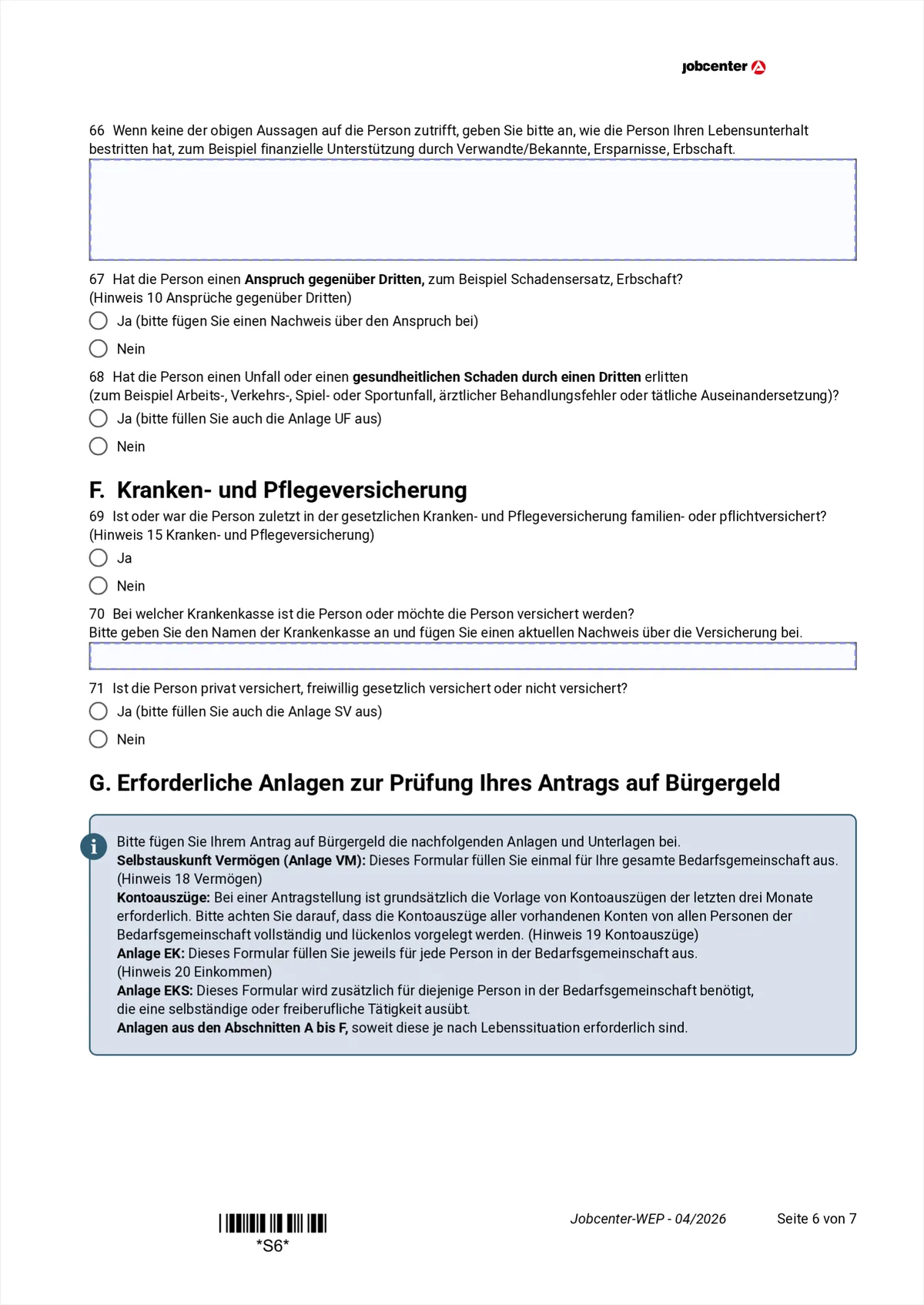
Hover or tap a marked field to see the explanation. Section E ends at the top with the catch-all field, then comes the health insurance. The lower half is not a fill-in area but the same Anlagen checklist as in the Hauptantrag.
- 66
- Catch-all field: if none of the questions about the last 5 years fit, describe in your own words what the person lived on, for example savings, help from relatives or an inheritance.
- 67
- Does the person have money claims against others, for example damages or an inheritance. If yes, attach evidence.
- 68
- Was the person harmed by an accident or by another person. If yes, the Anlage UF comes on top.
- 69
- Is or was the person covered by the statutory health and care insurance, as a family member or compulsorily.
- 70
- Name of the health insurer, for example TK, AOK or Barmer. Attach a current confirmation.
- 71
- Privately insured, voluntarily in the statutory scheme, or not insured at all. If yes, the Anlage SV comes on top.
- G
- Not a fill-in area but the checklist: Anlage VM on assets once for the whole Bedarfsgemeinschaft, bank statements of every account of every member for the last 3 months without gaps, Anlage EK for each person individually, Anlage EKS on top for self-employment.
Section F: health and care insurance
Section G: what to attach
7. Page 7: notes and signature (items 72-75)
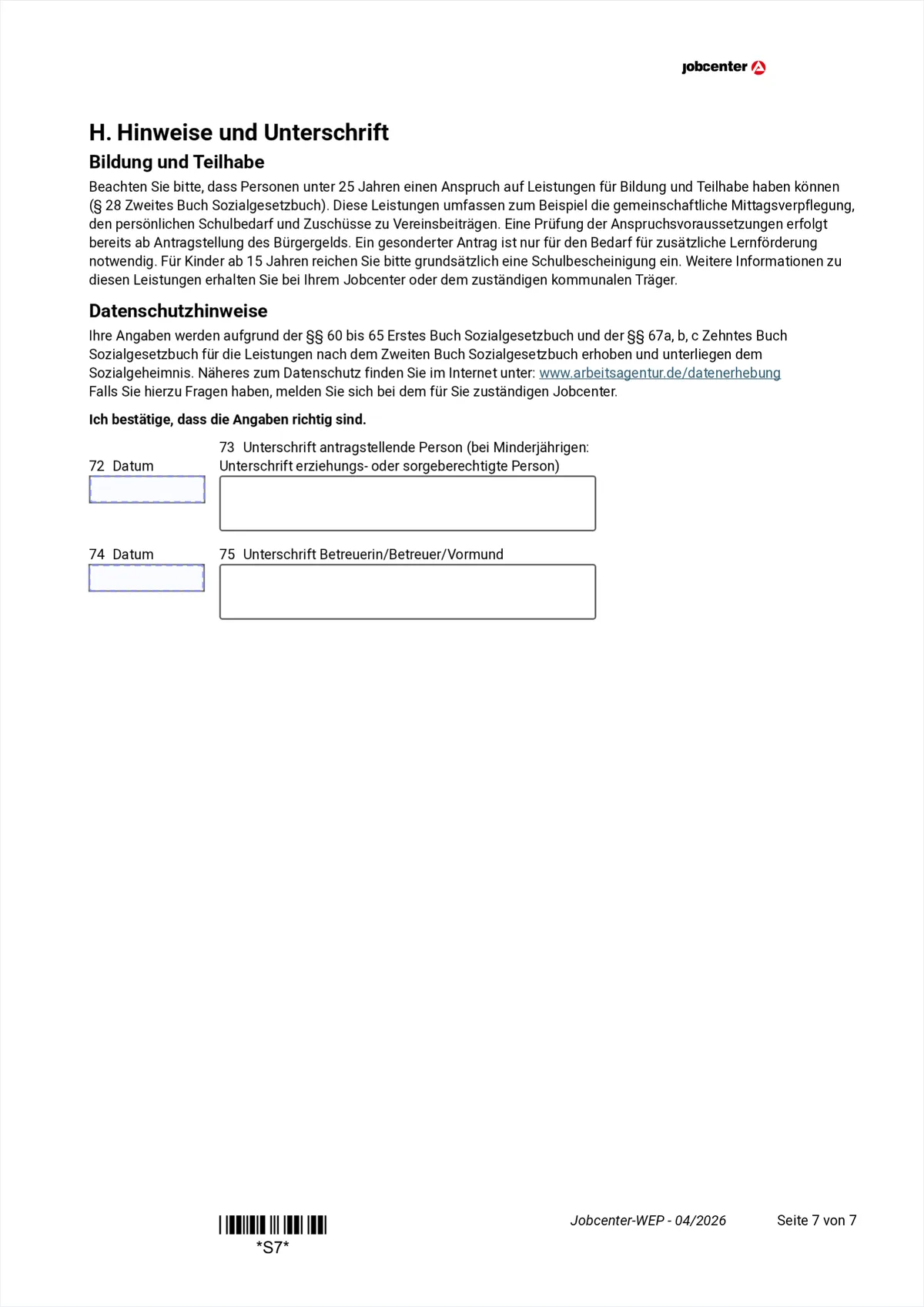
Hover or tap a marked field to see the explanation. Important at the end: the APPLICANT signs, not the person this Anlage is about. Above it stands the note on education and participation benefits for under-25s: school meals, school supplies and club fees.
- 72-73
- Date and signature of the applicant. For minors a parent or the legal guardian signs.
- 74-75
- Only with legal guardianship: date and signature of the guardian. Otherwise it stays empty.
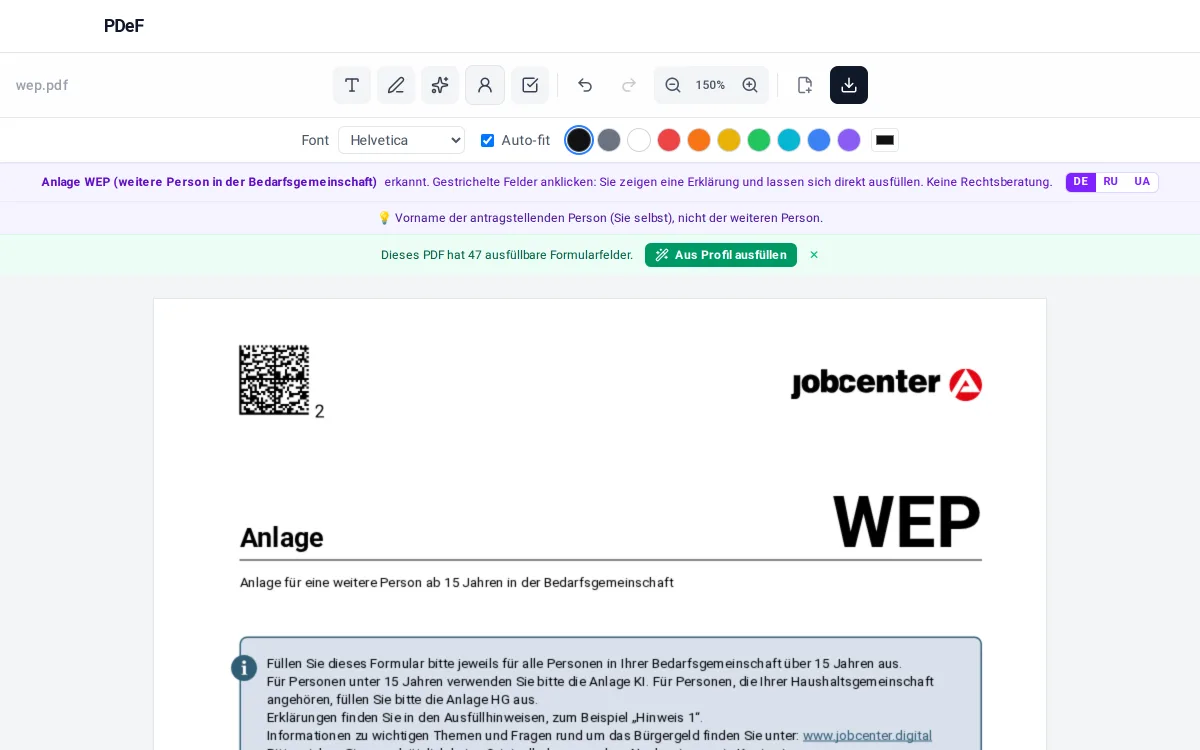
8. How to fill in the WEP with explanations right on the form
Download the Anlage WEP from jobcenter.digital or arbeitsagentur.de and open it in the free PDeF editor in your browser. The editor recognises the form automatically and marks the fields with dashed outlines: a click shows in plain language what belongs there. Because several people mean several WEPs, the template function helps: reopen the same file and the editor restores your entries, so you only change the details in section B. You can sign via QR code with your phone, and the finished PDF downloads without a watermark. The file is not uploaded to a server: everything happens in your browser.
Tips
- Agree the entries with the other person: as the applicant you represent the Bedarfsgemeinschaft and carry the duty to inform.
- Attach the necessary evidence for each person, for example an ID and, where there is income, the matching Anlage EK or EKS.
- Answer item 13 first: for relatives and other people you save yourself six pages and need the Anlage HG or VE instead.
- Item 36 is often overlooked: not employable AND the mark G in the severe disability pass together give their own extra allowance.
Note, not legal advice: who belongs to the Bedarfsgemeinschaft is decided by the Jobcenter under the statutory rules. For questions about an Einstehensgemeinschaft a social advice centre can help.
Werbung
Frequently asked questions
Who do I fill in an Anlage WEP for?
For every person aged 15 and over in your Bedarfsgemeinschaft, one form each. For children under 15 you use the Anlage KI, and for people in the household outside the Bedarfsgemeinschaft the Anlage HG.
What happens after item 13?
It decides how much of the form you fill in. A child, a spouse or a registered partner means the whole form; relatives and other people jump straight to the signature and need the Anlage HG or VE instead.
Who signs the WEP?
The applicant, not the person the Anlage is about. With legal guardianship the guardian signs in the box below.
What is special about item 36?
It only gives an extra allowance if both apply at once: the person is not employable AND holds a severe disability pass with the mark G. Attach evidence for it.
My teenager lives with both parents in turn, what do I enter?
Item 28 exists exactly for that, for 15- to 18-year-olds. It determines how the need is split between the two households.
Can I use the filled WEP for the next person?
Yes. Reopen the saved file in the editor: your entries are restored and you only change section B with the next person's details.
Free, no account, nothing uploaded to a server
Fill a PDF now