Anlage KI: what belongs in every item of the child form
The Anlage KI describes a child under 15 in your Bedarfsgemeinschaft: 5 pages, 51 numbered items. One is filled in for EVERY child under 15; from 15 you use the Anlage WEP instead. It is signed by the applicant, never by the child. This guide walks through the form page by page: above you see the original page, below it what belongs in each item and where to find the detail. The fields on the images are interactive: hover over them or tap them and the explanation appears. You see the same explanations while filling it in the PDeF editor, in German, Russian and Ukrainian.
1. Page 1: you and the child (items 1-15)
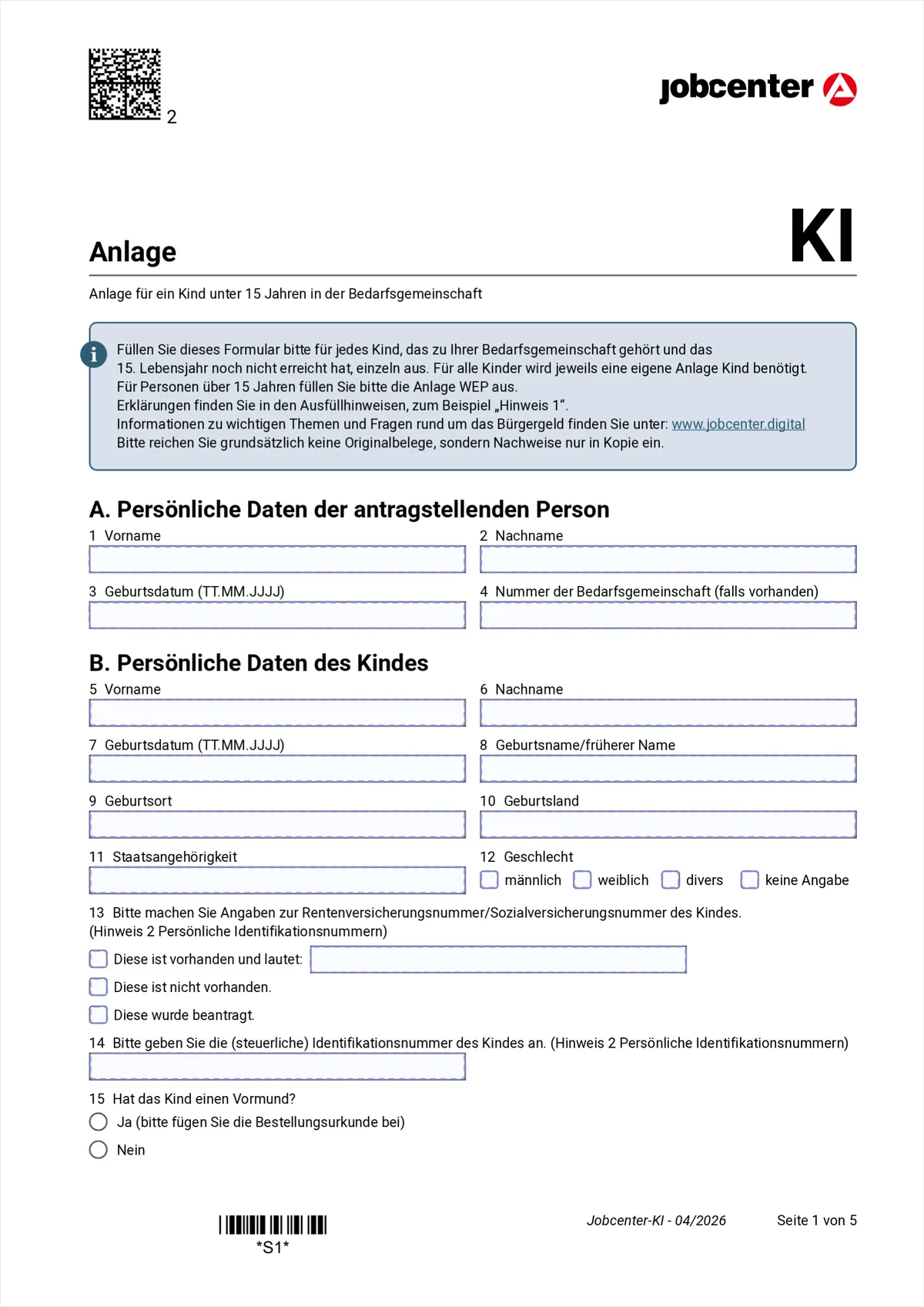
Hover or tap a marked field to see the explanation. Section A is the applicant, section B is the child. Every child under 15 gets its own form; there is no joint form for several children.
- 1-3
- First name, surname and date of birth of the applicant.
- 4
- Bedarfsgemeinschaft number, if you have one. It is printed at the top of every letter from the Jobcenter.
- 5-7
- First name, surname and date of birth of the child, as in the birth certificate.
- 8
- The child's former name, only if the name was changed, for example after an adoption.
- 9-11
- Place of birth, country of birth and nationality of the child.
- 12
- Sex, one tick: männlich, weiblich, divers or keine Angabe.
- 13
- The child's pension insurance number: tick one of the three options, exists with the number, does not exist, or has been applied for. Small children often do not have one yet.
- 14
- The child's tax identification number, 11 digits. It is issued automatically after birth and sent by letter.
- 15
- Does the child have a legal guardian. If yes, attach the appointment document.
Section A: who is applying
Section B: the child
2. Page 2: residence and living situation (items 16-27)
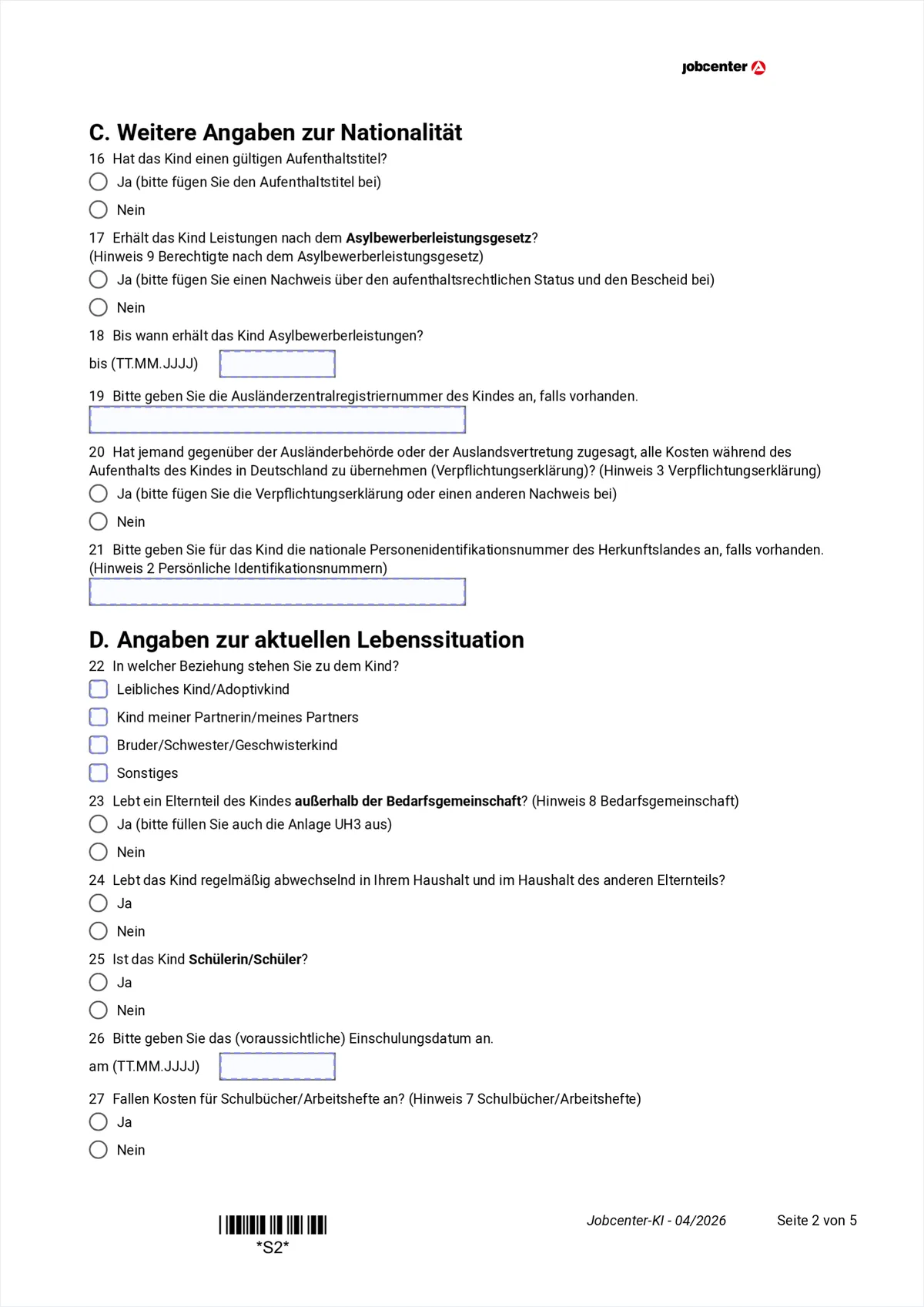
Hover or tap a marked field to see the explanation. Item 23 has the biggest consequences in the whole form: if one parent lives outside the Bedarfsgemeinschaft, the Anlage UH3 comes on top, which the Jobcenter uses to check maintenance claims against that parent.
- 16
- Does the child have a valid residence permit. If yes, attach a copy.
- 17-18
- Does the child receive benefits under the Asylbewerberleistungsgesetz and until when. The date is in the decision.
- 19
- The child's foreigners' register number (AZR-Nummer), if there is one.
- 20-21
- A formal undertaking to cover the child's costs, and the national personal identification number of the country of origin, each if applicable.
- 22
- How the child is related to you: own or adopted child, the child of your partner, a sibling, or something else.
- 23
- Does one parent of the child live OUTSIDE the Bedarfsgemeinschaft. If yes, the Anlage UH3 comes on top.
- 24
- Does the child live alternately with you and with the other parent. That determines how the need is split between the two households.
- 25-26
- Is the child at school, and the expected date of starting school. If no, items 26 and 27 stay empty.
- 27
- Are there costs for school books and exercise books.
Section C: residence
Section D: living situation
3. Page 3: school supplies, extra allowances and the child's own income (items 28-38)
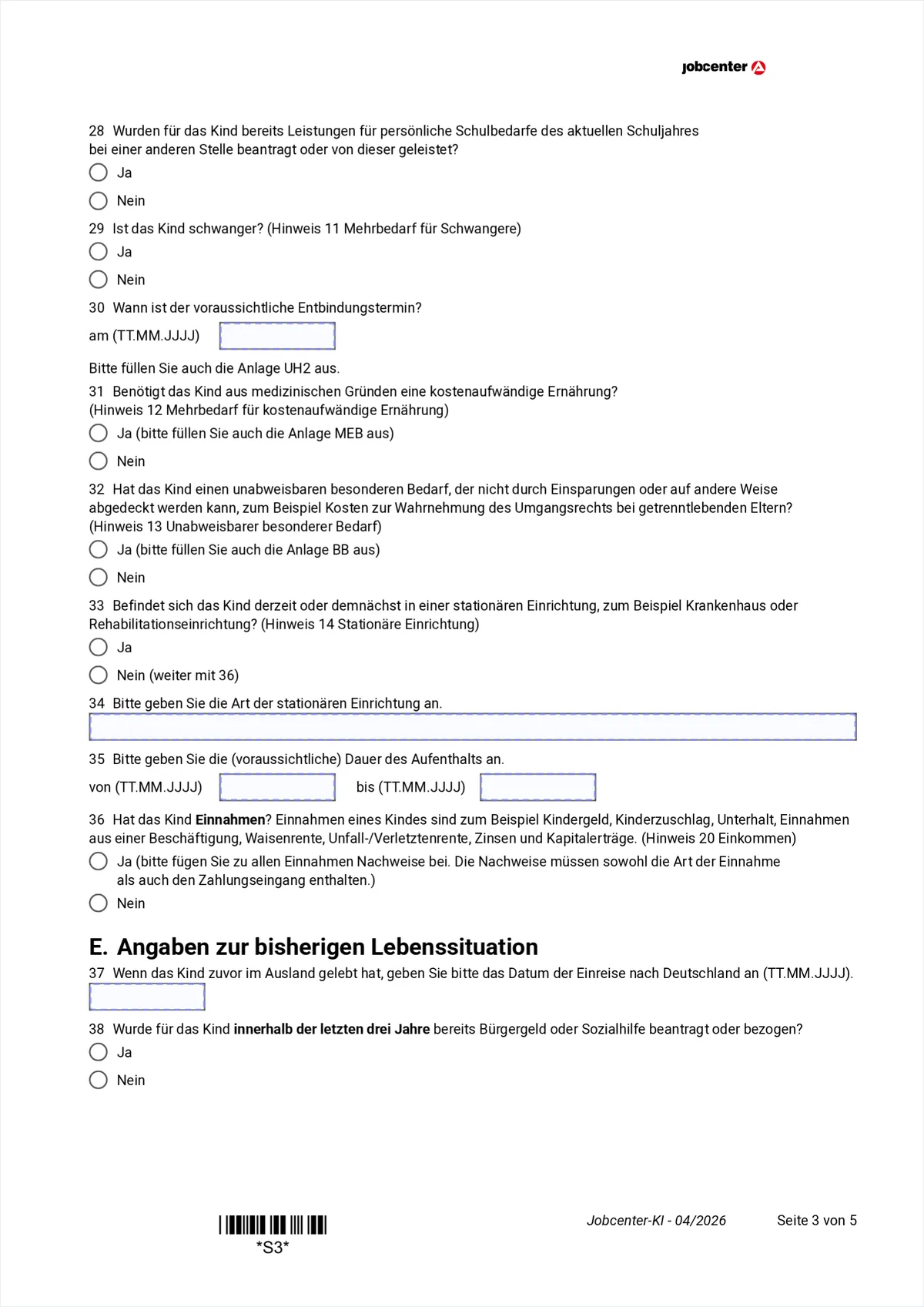
Hover or tap a marked field to see the explanation. Item 36 surprises many people: a child has income too. Kindergeld, maintenance or an orphan's pension belong to the child and have to be stated here.
- 28
- Have benefits for personal school supplies for this school year already been claimed from ANOTHER body or paid by one. The question prevents double payment, it is not a disadvantage.
- 29-30
- Is the child pregnant and what is the expected date. Surprising on a form for under-15s, but possible; it triggers an extra allowance and additionally the Anlage UH2.
- 31
- Does the child need a costly diet for medical reasons. If yes, the Anlage MEB comes on top.
- 32
- An unavoidable special need, for example costs for contact with the parent living apart. If yes, the Anlage BB comes on top.
- 33-35
- Is the child currently or soon in a stationary facility such as a hospital or rehab, plus the type and the period. If no, continue with item 36.
- 36
- Does the child have income. This means for example Kindergeld, Kinderzuschlag, maintenance, income from a job, an orphan's pension, an accident pension, and interest and capital gains. For every income the Jobcenter needs evidence showing the KIND and the ARRIVAL of the money.
- 37-38
- Date of entry into Germany, if the child lived abroad before, and whether Bürgergeld or Sozialhilfe was already received in the last 3 years.
Section E: the previous situation
4. Page 4: earlier benefits and claims (items 39-47)
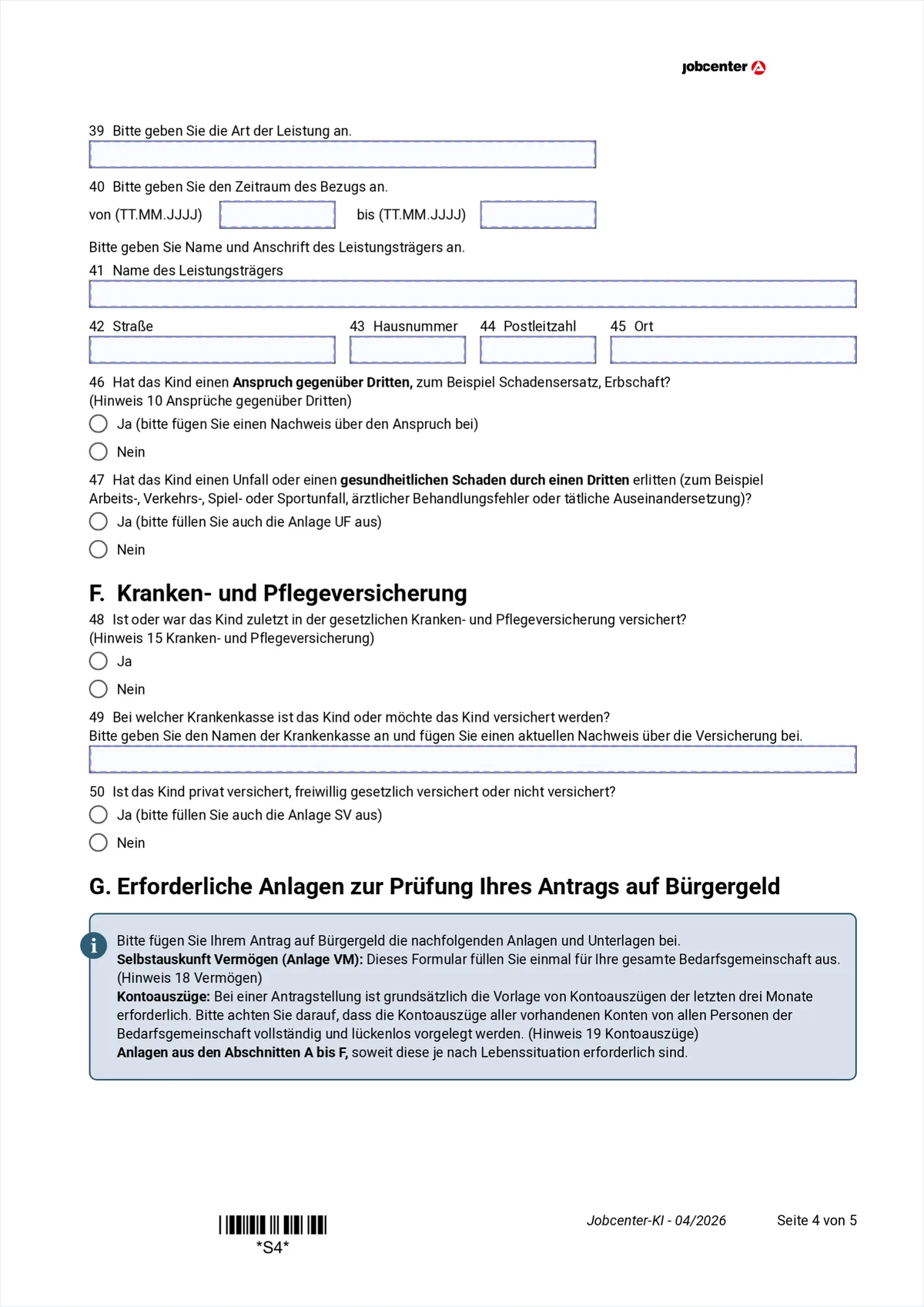
Hover or tap a marked field to see the explanation. The whole block stays empty if item 38 was answered with no. Otherwise every detail is printed at the top of the old decision letter.
- 39-40
- Which benefit the child received and for which period.
- 41-45
- Name and full address of the authority that paid: name, street, house number, postcode, town.
- 46
- Does the child have money claims against others, for example damages or an inheritance. If yes, attach evidence.
- 47
- Was the child harmed by an accident or by another person. If yes, the Anlage UF comes on top.
5. Page 5: health insurance and signature (items 48-51)
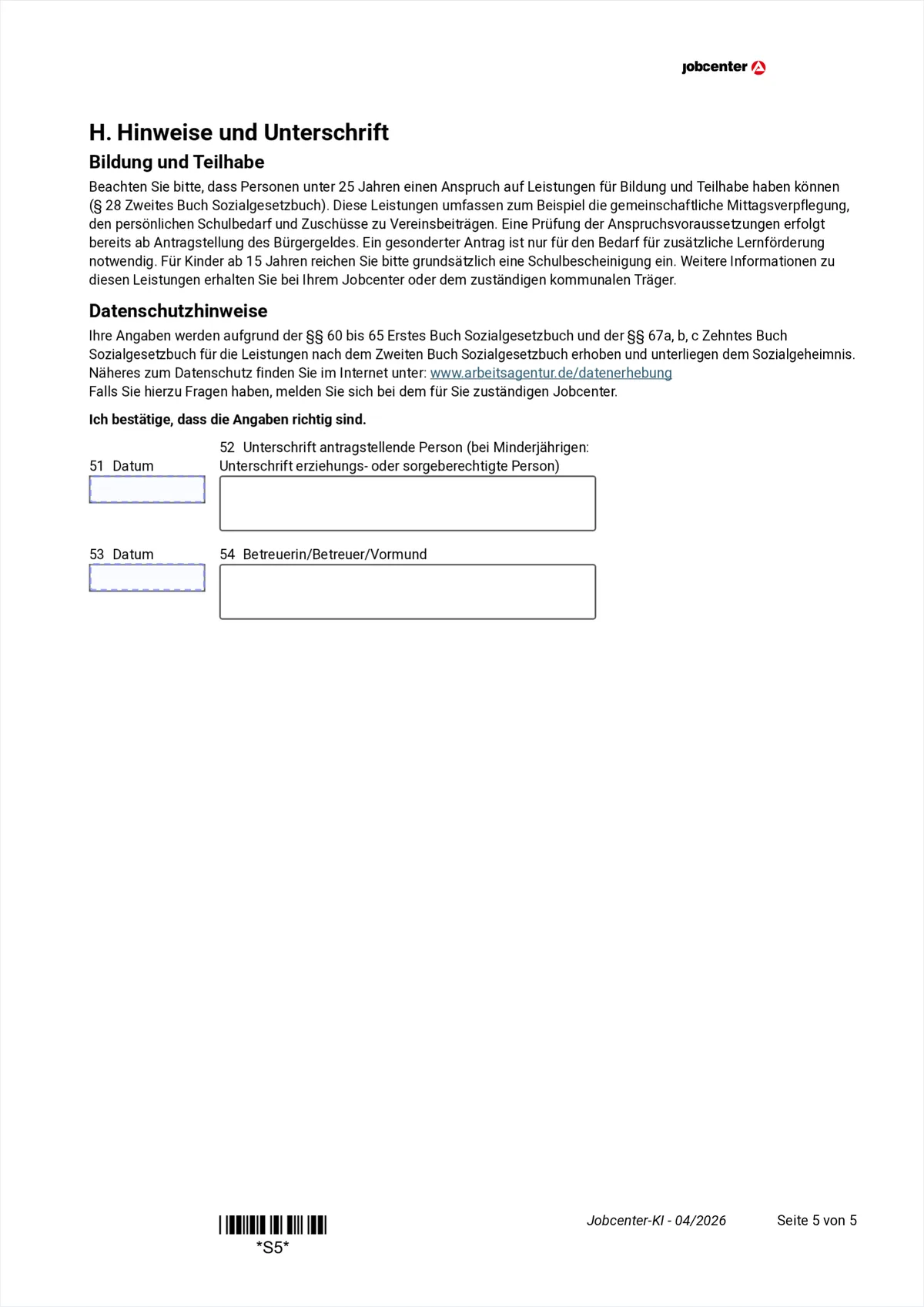
Hover or tap a marked field to see the explanation. Finally the health insurance and the signature. The applicant signs, not the child.
- 48
- Is or was the child insured in the statutory health and care insurance, as a family member or compulsorily. Children are usually covered through a parent.
- 49
- Privately insured, voluntarily in the statutory scheme, or not insured at all. If yes, the Anlage SV comes on top.
- 50-51
- Date and signature of the applicant. With legal guardianship the guardian signs in the box below.
Section F: health insurance
6. How to fill in the KI with explanations right on the form
Download the Anlage KI from jobcenter.digital or arbeitsagentur.de and open it in the free PDeF editor in your browser. The editor recognises the form automatically and marks the fields with dashed outlines: a click shows in plain language what belongs there. Because every child needs its own KI, the template function helps especially here: reopen the same file and the editor restores your entries, so you only change section B. You can sign via QR code with your phone, and the finished PDF downloads without a watermark. The file is not uploaded to a server: everything happens in your browser.

Tips
- One Anlage KI per child under 15. From the 15th birthday the Anlage WEP applies instead.
- Do not skip item 36: Kindergeld, maintenance and an orphan's pension are the CHILD's income and belong here, not in your own Anlage EK.
- With separated parents, item 23 pulls in the Anlage UH3 and item 24 decides how the need is split between the two households.
- The applicant signs. The child does not sign, not even shortly before turning 15.
Note, not legal advice: how a child's income is counted and which extra allowances are recognised is decided by your Jobcenter. For questions, the official filling instructions of the Bundesagentur für Arbeit or a social advice centre can help.
Werbung
Frequently asked questions
Which children need an Anlage KI?
Every child under 15 belonging to your Bedarfsgemeinschaft, one form each. For children aged 15 and over you use the Anlage WEP instead.
Do I have to state the Kindergeld here?
Yes. Kindergeld is the child's income and belongs in item 36, together with maintenance, Kinderzuschlag, an orphan's pension and interest. Attach evidence showing the kind and the arrival of the money.
What does it mean if one parent lives outside the Bedarfsgemeinschaft?
Then you additionally fill in the Anlage UH3. The Jobcenter uses it to check the child's maintenance claims against that parent; this is a standard procedure and not a disadvantage for you.
The child lives with both parents in turn, what do I enter?
Tick yes in item 24. In a genuine shared-custody arrangement the child's need is split between the two households; the Jobcenter needs this to calculate correctly.
Who signs the Anlage KI?
The applicant, that is the parent or the legal guardian. The child does not sign. With legal guardianship the guardian signs in the box below.
Can I use the filled KI as a template for the next child?
Yes. Reopen the saved file in the editor: your entries are restored and you only change section B with the next child's details.
Free, no account, nothing uploaded to a server
Fill a PDF now